Summary:
If your yard is still soggy two days after a rainstorm — or you’ve noticed a musty smell in your crawl space that wasn’t there last year — you’re not imagining things getting worse. Drainage problems on Long Island tend to compound quietly until they become expensive. The good news is that most of them are fixable. The better news is that fixing them properly the first time costs a fraction of what foundation repair or crawl space remediation runs. This guide walks through what’s actually causing the problem, what the solutions look like, and what you should expect from a contractor who knows Suffolk County’s specific conditions.
Why Landscape Drainage Is So Difficult on Long Island's East End
Suffolk County has a drainage problem that most of the country doesn’t — and it comes down to a combination of geography, aging housing stock, and weather that’s getting harder to ignore. A significant portion of Hamptons-area homes were built in the 1960s, during a prolonged drought when the water table sat 5 to 10 feet lower than it does today. The drainage systems designed for those properties simply weren’t built for current conditions.
Add to that the August 2024 storm that dropped 10 inches of rain across northern Suffolk County in a single day — bursting the Mill Pond dam, flooding Stony Brook University, and sending water into hundreds of basements — and you start to understand why “it’s always been fine” is no longer a reliable assumption. The ground here has changed. The storms have changed. And a lot of the drainage hasn’t kept up.
How Suffolk County's Soil Makes Drainage Harder Than Most Contractors Expect
One of the most common mistakes we see contractors make on Long Island is treating drainage like a one-size-fits-all problem. It isn’t — especially in Suffolk County, where the soil conditions shift dramatically depending on where you are.
On the South Shore, including much of the Hamptons coastline, the soil is sandy and porous. Under normal conditions, it drains fast. But during a major storm or a prolonged wet stretch, the water table rises and that sandy soil becomes fully saturated. When that happens, a dry well that worked fine last summer suddenly has nowhere to send the water. The system backs up. The yard floods. And a contractor who installed the right solution for the wrong conditions gets a call they weren’t expecting.
The North Shore and inland areas of Suffolk County tell a different story. The soil there tends to be heavier and clay-rich, which means it drains slowly under normal conditions. Chronic pooling, persistently soggy patches, and water that creeps toward the foundation over weeks rather than hours — these are the typical complaints. French drains and surface regrading tend to be more effective here, but only when they’re installed with a proper outlet and enough slope to actually move water.
This is why a real site assessment matters before anything gets dug up. You need to know what kind of soil you’re working with, where the water table sits, and what the water is actually doing before you can design a system that will hold up. Skipping that step is how you end up paying for a drainage system twice.
On coastal properties — particularly anything near the Atlantic, Peconic Bay, or Shinnecock Bay — there’s another layer to consider. Metal drainage components corrode faster in salt air. Grates, frames, and fittings that would last decades inland can fail within a few years if the wrong materials are specified. That’s not a detail most contractors from outside the area think about. It’s one we account for on every coastal job.
Crawl Space Drainage System: What It Is and Why Hamptons Homes Need One
A lot of Hamptons-area homes — particularly older properties and those built on the North Shore — have crawl spaces rather than full basements. And in a coastal environment with a high water table, those crawl spaces are one of the most vulnerable parts of the entire structure.
Exterior landscape drainage is the first line of defense. When water is redirected away from the foundation before it reaches the crawl space, you’ve solved the problem at its source. But in Suffolk County, especially during major storms or extended wet periods, groundwater can rise from below rather than flowing in from the surface. That’s when exterior drainage alone isn’t enough.
A crawl space drainage system handles what gets through. The most common approach involves a perimeter drain channel installed along the interior base of the crawl space walls, which collects water that enters and routes it to a sump pump. The pump then moves that water away from the structure. A vapor barrier — sometimes called encapsulation — is typically installed along the ground and walls to block moisture from rising up through the soil.
The reason this matters goes beyond keeping the floor dry. Persistent moisture in a crawl space leads to mold growth, which creates air quality problems throughout the home. It accelerates wood rot in the floor joists and structural framing. It attracts pests. And it can quietly compromise the structural integrity of the home over years before anyone notices. On a Hamptons property worth well into the seven figures, that’s not a small risk.
What a lot of homeowners don’t realize is that crawl space drainage and landscape drainage are connected systems, not separate ones. If the exterior drainage is doing its job — moving surface water away from the foundation, managing runoff from the roof, correcting the grade so water flows away from the house — the crawl space system has far less work to do. When we design drainage for a property, we look at both together. Fixing one while ignoring the other is how you end up with a dry crawl space and a flooded yard, or a dry yard and a wet crawl space.
Suffolk County’s licensing requirements apply to crawl space drainage work just as they do to exterior systems. Under Suffolk County Code Article II, drainage systems are explicitly listed among the work types that require a Home Improvement Contractor License from the Suffolk County Office of Consumer Affairs. Homeowners who hire unlicensed contractors for this work take on real legal and financial exposure — and there’s no warranty waiting for them if the system fails.
What a Proper Landscape Drainage Fix Actually Looks Like
The right drainage solution depends entirely on what’s causing the problem. That sounds obvious, but it’s where a lot of projects go wrong. The most common mistake is applying a French drain to every situation regardless of whether the soil can actually absorb the redirected water — or whether there’s even a proper outlet for it to discharge into.
A French drain works by collecting water through perforated pipe wrapped in filter fabric and moving it downslope to a safe discharge point. It’s effective for a wide range of situations, but it requires adequate slope (at least a 1-inch drop per 10 feet), the right soil conditions, and somewhere for the water to actually go. Without all three, you’ve built a water collection trench, not a drainage system.
Dry wells, catch basins, channel drains, and regrading all serve different purposes and work best in different conditions. The solution that lasts is the one matched to your specific property — not the one that’s fastest to install.
How Drainage Connects to Your Irrigation System and Overall Landscaping
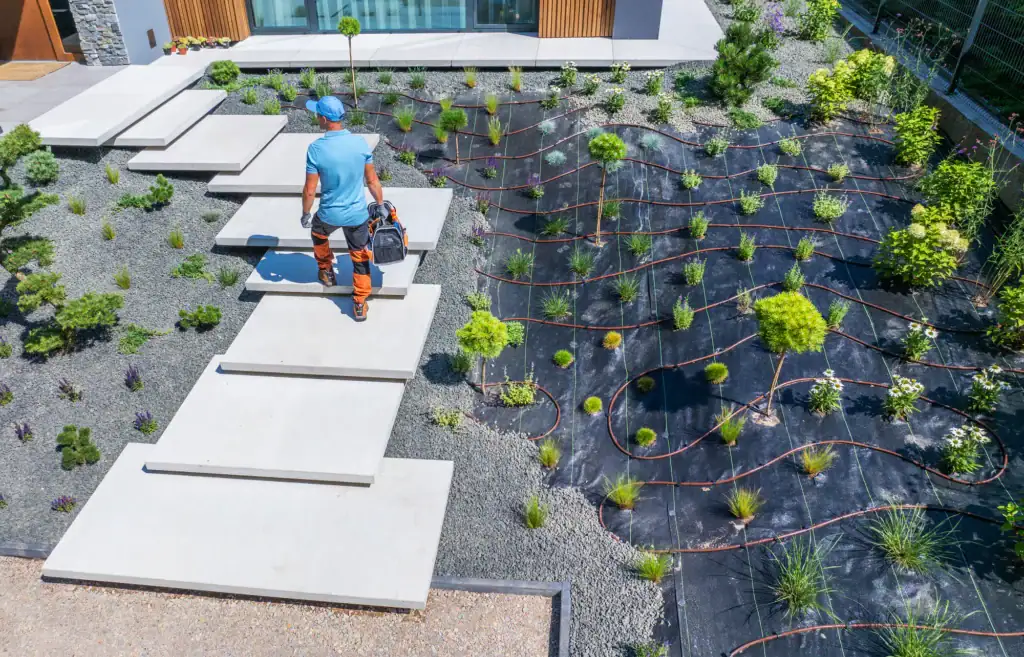
Drainage rarely fails in isolation. In most cases, a soggy yard or a wet foundation is the result of multiple systems not working together — the grade is slightly off, the irrigation is overwatering, the downspouts are discharging too close to the house, and the existing drainage can’t keep up with the combined load.
This is why drainage planned after the fact almost always costs more and works worse than drainage that’s integrated from the start. When we’re installing new landscaping, we factor drainage and irrigation into the design before anything goes in the ground. The grade is set to move water away from the structure. The irrigation is calibrated so it’s not adding to an already saturated situation. The drainage system has a clear path to discharge. Everything is designed to work together.
For properties that already have landscaping and irrigation in place, the assessment is more involved. We look at where water is entering the property, where it’s pooling, how the existing grade is directing flow, and whether the irrigation schedule is contributing to the problem. Sometimes the fix is straightforward — a regrading correction or a downspout extension. Sometimes it requires a more complete drainage system. But the starting point is always understanding the full picture, not just the symptom.
Irrigation systems that aren’t coordinated with drainage can quietly make things worse over time. Overwatering on already-saturated soil adds volume the ground can’t absorb, which pushes water toward the foundation and into low spots. If your yard floods after rain but also stays soggy for days after the irrigation runs, that’s a signal the two systems need to be looked at together. We handle both, which means we can address the problem at every point rather than patching one piece while another keeps feeding it.
FAQs: Landscape Drainage in Suffolk County, NY
How much does landscape drainage cost on Long Island? A French drain or yard drainage system typically runs between $1,000 and $4,000, depending on the scope, the soil conditions, and the complexity of the outlet situation. Crawl space drainage systems vary more widely based on the size of the space and what’s involved. What’s worth keeping in mind is that foundation repair — which is often where deferred drainage problems end up — starts at $5,000 and can run well past $30,000. Drainage installation is almost always the cheaper path.
Do I need a permit for drainage work in Suffolk County? Yes. In Suffolk County, drainage systems fall under the Home Improvement Contractor License requirement — meaning the contractor performing the work must be licensed through the Suffolk County Office of Consumer Affairs. For properties near wetlands, tidal waters, or coastal areas — which describes a significant portion of the Hamptons — additional permits from the Town and potentially the NYS DEC may be required. Southampton and East Hampton both have their own building department requirements on top of the county-level rules. We’ve been navigating these requirements in Suffolk County for over 20 years, and we handle all permitting as part of the project scope.
How long will a drainage system last? A properly installed system using commercial-grade materials — non-woven geotextile filter fabric, correctly sized perforated pipe, and a well-designed outlet — should last 15 to 25 years with minimal maintenance. The systems that fail early usually come down to one of three things: improper slope, cheap fabric that clogs within a few years, or no real outlet. Those aren’t material failures — they’re installation failures.
Why does my yard flood even though it drained fine for years? This is one of the most common questions we hear from homeowners in Southampton, Water Mill, and Amagansett. The honest answer is that Suffolk County’s water table has risen significantly since most of these homes were built. A drainage system designed for 1968 conditions — when the water table sat lower — isn’t built for what the ground is doing now, especially after major storms. The property didn’t change. The conditions did.
What’s the difference between a French drain and a dry well? A French drain moves water — it collects it through perforated pipe and redirects it to a discharge point away from the problem area. A dry well collects water in one place and slowly releases it into the surrounding soil. Which one works depends on your soil’s absorption rate and whether you have a viable outlet for a French drain. In high water table situations common throughout Suffolk County, dry wells can become ineffective because the surrounding soil is already saturated. A perc test — which measures how quickly your soil absorbs water — is the right way to determine which approach makes sense for your property.
Getting Landscape Drainage Right the First Time in Suffolk County
Drainage problems on Long Island don’t fix themselves, and they don’t stay the same size. What starts as a soggy patch in the yard or a faint musty smell in the crawl space tends to become a foundation issue or a mold problem if it’s left alone long enough. The good news is that the fix — when it’s done correctly — holds up for decades.
The key word there is correctly. That means a real site assessment before anything gets installed, materials that are built for coastal conditions, proper slope and outlet planning, and someone who understands how drainage, irrigation, and landscaping interact as a system rather than treating each one as a separate problem.
We back every drainage project with a one-year warranty on both labor and materials — no fine print, no conditions. If something isn’t working the way it should within that first year, we come back and make it right. If you’re dealing with standing water, a wet crawl space, or drainage that’s been “fixed” before and still isn’t working, call us at (631) 678-5629. We’re based in Southampton and we work across Suffolk County and the Hamptons.