Summary:
You come back in June. The irrigation ran all winter. Something died, something else took over, and the whole thing looks like it’s been unsupervised — because it has been. That’s the reality for most Hamptons second-home owners, and it’s not a maintenance failure. It’s a design problem. Xeriscape is a landscaping approach built around plants that don’t need constant intervention to survive and look good. For a property that sits empty from Labor Day to Memorial Day, that’s not a luxury — it’s the only approach that actually makes sense.
What Is Xeriscape and Why Does It Matter for Landscape Design?
Xeriscape — the word comes from the Greek “xeros,” meaning dry — is a landscape design philosophy centered on water efficiency and plant selection suited to your actual climate. We developed our xeriscape approach based on principles established in 1981 by the Denver Water Department, but the concepts translate well beyond the Southwest. The core idea is simple: choose the right plants for your conditions, group them by water needs, and let the landscape do most of the work.
What xeriscape is not is a gravel lot with a cactus in the corner. That misconception keeps a lot of homeowners from exploring it seriously. A well-designed xeriscape in Zone 7b — which covers most of the Hamptons coastline — can include ornamental grasses, lavender, rugosa roses, coneflowers, bayberry, and beach plum. It can look layered, seasonal, and genuinely beautiful. It just doesn’t need to be babied.
The Seven Principles Behind a Xeriscape That Actually Works
Xeriscape isn’t a single technique — it’s a framework. The seven principles that guide it have held up for decades because they’re practical, not theoretical.
It starts with planning and design. Before a single plant goes in the ground, the site gets analyzed — sun exposure, wind patterns, proximity to the ocean or bay, existing drainage. On the South Fork, that last one matters more than most places. Hamptons properties often sit within a mile or two of the Atlantic or the Peconic, and salt spray changes what will and won’t survive. A design that ignores that is a design that fails.
Soil analysis comes next. The South Fork sits on glacial outwash deposits — predominantly sandy, fast-draining soil that’s low in organic matter. Drought-tolerant plants can handle lean conditions, but they still need a viable establishment period. Amending the soil with organic matter gives them that without turning the whole property into something it isn’t.
From there, the principles cover appropriate plant selection, reducing high-water turf areas, efficient irrigation, mulching, and ongoing maintenance. That last one is worth pausing on. Xeriscape doesn’t mean zero maintenance — it means the right maintenance, done less often. Periodic pruning, occasional weeding, a mulch refresh every season or two. For a property that’s occupied three months a year, that’s a manageable schedule. For a conventional lawn, it isn’t.
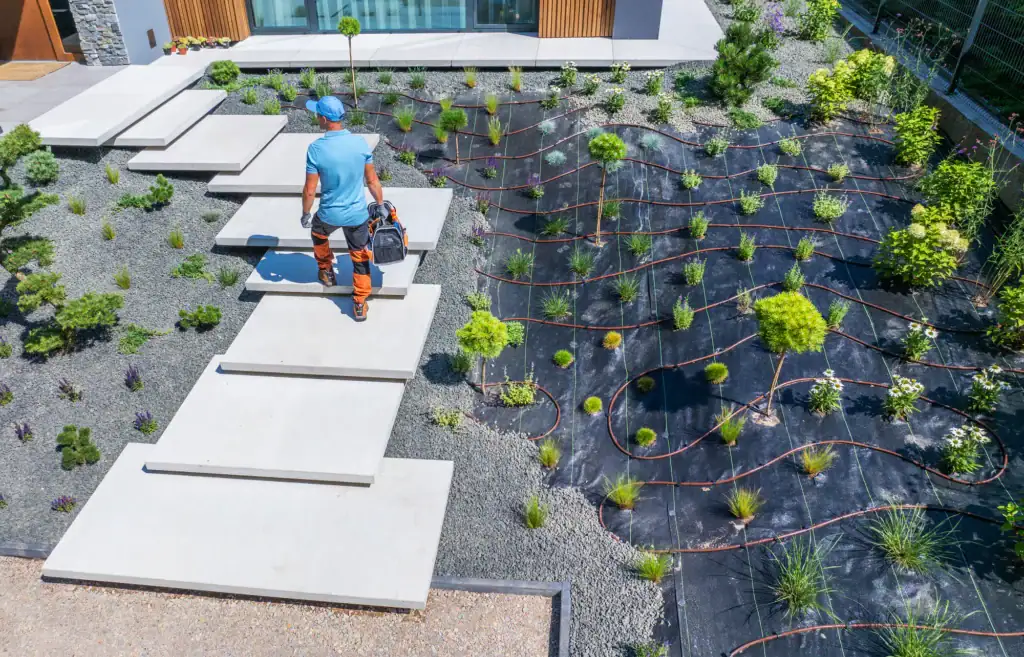
The irrigation piece is where a lot of people get confused. Xeriscape doesn’t mean ripping out your system. It means rethinking how it’s used. A smart drip system integrated with a xeriscape design functions as a backup — handling the establishment period and the occasional drought — not as the primary water source. Once plants are established, they largely take care of themselves. The irrigation is there for edge cases, not daily operation. For an absentee owner, that distinction is everything. Your system isn’t running unattended all winter on a schedule set for a different season.
What Xeriscape Actually Looks Like on a South Fork Property
The visual concern is real, and it’s worth addressing directly. Most people picture xeriscape and think of something stark — rock mulch, spiky plants, a lot of brown. That’s a desert xeriscape, and it has nothing to do with what works on Long Island’s East End.
Zone 7b supports a wide range of plants that are both drought-tolerant and genuinely attractive. Ornamental grasses move in the coastal wind and hold their structure through winter. Bayberry is a native shrub that handles sandy soil, salt spray, and deer pressure simultaneously — and it smells good. Rugosa rose is tough enough to grow on barrier beaches and flowers prolifically. Sea lavender has exceptional salt tolerance. Pitch pine is a coastal native that’s been anchoring South Fork landscapes for centuries.
The point isn’t to recite a plant list. The point is that there’s no shortage of species that thrive in Hamptons conditions and look the part. A well-designed xeriscape here doesn’t look like it’s compensating for anything. It looks intentional — which, in a market where landscape aesthetics carry real weight, matters.
There’s also a practical dimension to the plant selection that goes beyond water use. Most of the species that perform well in a South Fork xeriscape are naturally deer-resistant. Lavender, ornamental grasses, yarrow, coneflower, Russian sage — deer tend to leave these alone. In a place where white-tailed deer can dismantle a conventional planting in a single night, that’s not a minor benefit. It’s the difference between a landscape that holds up over a seven-month absence and one that doesn’t.
Research consistently shows that quality landscape design increases property values by 5 to 15 percent. In a market like Southampton or East Hampton, where property values are already significant, that range represents real money. A xeriscape that looks polished, holds up through the off-season, and requires minimal intervention isn’t just a maintenance solution — it’s an asset.
Landscape Maintenance for Hamptons Homes With Long Off-Seasons
The maintenance reality of a Hamptons second home is specific, and most landscape services aren’t designed around it. A property that’s occupied from late May to early September and empty the rest of the year doesn’t need weekly attention — it needs a design that can go quiet and come back looking right.
Xeriscape reduces yearly landscape maintenance costs by up to 87 percent compared to conventional turf. That number reflects a real shift: no weekly mowing, minimal fertilizing, no pest control cycles tied to a lawn that doesn’t need to exist. What remains is periodic maintenance — pruning, weeding, mulch refresh — that can be scheduled around your actual presence rather than a calendar that assumes you’re there.
How Xeriscape Handles the Months Your Property Is on Its Own

The honest answer is that no landscape is truly maintenance-free. But xeriscape comes closer than anything else for a property with a long off-season, and the reasons are structural, not just marketing language.
Plants selected for Zone 7b coastal conditions — the sandy soil, the salt air, the deer pressure — don’t need weekly intervention to survive. They’re chosen specifically because they’re adapted to the environment they’re going into. Once established, they handle dry periods, coastal wind, and the occasional hard frost without requiring someone to check on them. That’s a meaningful distinction from a conventional planting that needs regular irrigation adjustments, fertilization, and pest management to stay healthy.
The irrigation component matters here too. A smart drip system can be set to run minimally during the off-season — just enough to prevent total desiccation during an unusually dry stretch — and then adjusted remotely when conditions change. You’re not relying on a timer that was programmed in July to make good decisions in November. The system responds to actual conditions, and the plants are selected to need very little from it in the first place.
Mulching is the other piece that often gets underestimated. Two to four inches of organic mulch retains soil moisture, regulates temperature, and suppresses the majority of weed growth. It’s not glamorous, but it’s one of the most effective tools in a low-maintenance landscape. For a property that’s empty most of the year, it means you’re not returning in June to find the beds overtaken.
The result is a landscape that looks cared for when you arrive, doesn’t generate emergencies while you’re away, and doesn’t require a weekly service call to stay that way. For a Hamptons second home, that’s the design goal. Everything else is secondary.
Common Questions About Xeriscape in Southampton and East Hampton
**Does xeriscape actually work in Long Island’s climate?**
Yes — and the Hamptons’ specific conditions make it particularly well-suited. Zone 7a and 7b support a wide range of drought-tolerant species. The sandy glacial outwash soil that makes conventional turf high-maintenance is actually a natural fit for xeriscape-appropriate plants, which prefer fast drainage over heavy clay. The challenge isn’t the climate — it’s selecting species that also handle salt spray and deer pressure, which is where local knowledge matters. We’ve worked in Southampton, East Hampton, and Bridgehampton long enough to know which plants actually perform in these specific conditions.
**Do I need permits for xeriscape work in Southampton or East Hampton Town?**
Depending on the scope of the project, yes. Grading, drainage modifications, and certain hardscape elements require permits under Southampton Town and East Hampton Town codes. This is one of the areas where working with a licensed contractor makes a real difference. We handle all necessary Suffolk County permits — you don’t have to navigate local bureaucracy from a Manhattan office while trying to coordinate a project remotely.
**Will my irrigation system become useless if I switch to xeriscape?**
Not at all. A well-designed xeriscape integrates with your existing irrigation rather than replacing it. The shift is in how the system is used — from a primary water source running on a fixed schedule to a smart backup that responds to actual conditions. Drip irrigation paired with drought-tolerant plantings is one of the most effective combinations for an absentee owner, because the system only runs when it genuinely needs to. Outdoor water use can drop by 50 to 75 percent compared to conventional landscaping, which also means your water bills reflect that.
**What does xeriscape cost compared to conventional landscaping?**
Installation runs roughly $5 to $20 per square foot, which is in the same range as traditional landscaping. The difference shows up over time — most homeowners recoup any cost difference within three to five years through reduced water bills and dramatically lower maintenance costs. For a Hamptons property, the property value angle is also worth factoring in. Quality landscape design consistently increases home values, and a landscape that holds up through a long off-season without looking neglected is part of what drives that.
Is Xeriscape the Right Choice for Your Hamptons Property?
If your property sits empty for most of the year, and you’re tired of returning in June to a landscape that’s been fighting for its life since September, xeriscape is worth a serious look. It’s not a compromise — it’s a design approach built around the reality of how second homes on the South Fork actually get used.
The plants are selected for Zone 7b, for sandy soil, for salt air, for deer. The irrigation works as a backup, not a crutch. The maintenance is periodic, not constant. And the result is a landscape that looks right whether you’re there or not.
We’ve been working on Hamptons properties in Southampton, East Hampton, and Bridgehampton for twenty years. We know what grows here, what doesn’t, and what the specific combination of coastal conditions and absentee ownership actually requires from a landscape design. Every project comes with a one-year warranty on labor and materials, and we handle all necessary Suffolk County permits from start to finish. If you’re ready to stop managing a landscape problem and start having a landscape that works, reach out to us and let’s talk through what that looks like for your property.