Summary:
If you’re planning a landscape project in the Hamptons, the first thing worth knowing is that “the Hamptons” isn’t one place — not really. Southampton and East Hampton have different histories, different property types, and genuinely different design sensibilities. What works on a formal Southampton estate doesn’t automatically translate to a contemporary East Hampton property, and vice versa. Add in the realities of sandy glacial soil, relentless deer pressure, and salt spray from prevailing coastal winds, and you’re dealing with a market that punishes generic landscaping fast. This guide walks through what makes each town distinct, what the land actually demands, and how to think about landscape design before a single plant goes in the ground.
Garden Landscape Design in Southampton vs. East Hampton: What's Actually Different
The simplest way to describe the difference is this: Southampton tends toward formality, and East Hampton tends toward expression. That’s a generalization, but it holds up when you look at the properties that define each town.
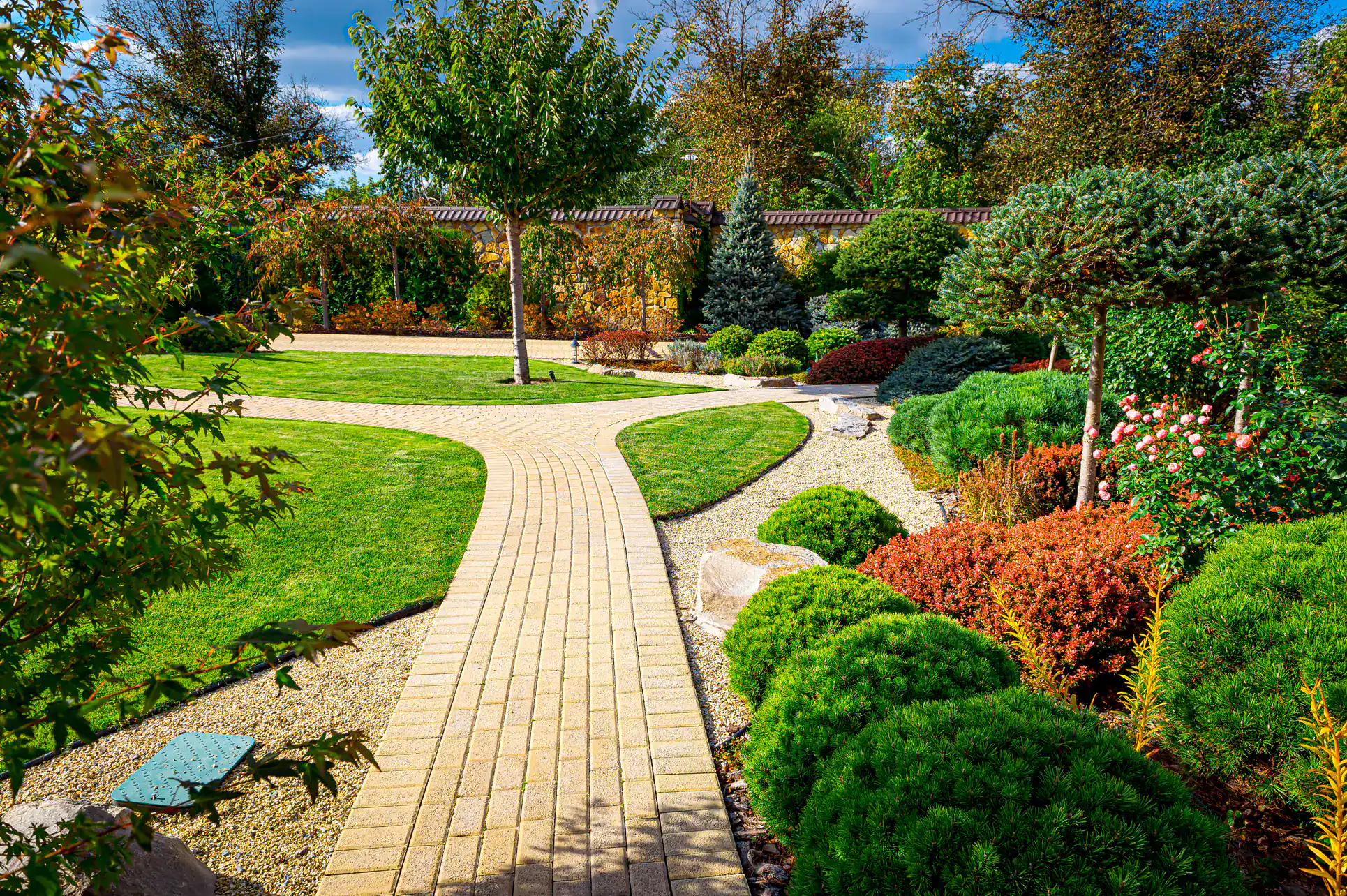
Southampton’s landscape tradition is rooted in the estate era. Think Meadow Lane — grand oceanfront properties where the landscape is part of the architecture. Symmetrical hedgerows, manicured lawn panels, formal rose gardens, and entry allées that announce the property before you reach the front door. The privet hedge is everywhere in Southampton, clipped tight, used to frame and divide rather than simply screen. Boxwood parterres, structured perennial borders, and clean sight lines define the aesthetic.
East Hampton reads differently. Further Lane and the Georgica Pond area attract a more contemporary sensibility — owners who want the landscape to make a statement, not just maintain tradition. You see more native plantings, architectural specimen trees, ornamental grasses used as design elements, and a willingness to let the landscape feel more alive and less controlled. The formality is still there in the bones, but it’s worn more loosely.
Yard Design in the Hamptons: Why the Whole Property Has to Work as One System
One of the most common mistakes in Hamptons landscape projects is treating the yard as a collection of separate decisions — the planting beds over here, the hardscape over there, the irrigation as an afterthought once everything else is in. That approach creates problems that show up fast, especially on properties with the sandy, fast-draining glacial outwash soil that covers most of the South Fork.
Sandy soil doesn’t hold water the way loamy or clay-rich soil does. Plants that would establish easily in other markets need consistent irrigation here, particularly in the first season. If the irrigation system isn’t designed and installed in coordination with the planting plan — accounting for root zones, drainage patterns, and sun exposure — you’re setting the landscape up to fail before summer even starts. We’ve seen it happen on properties where the planting contractor and the irrigation contractor never spoke to each other. The result is dead plants, frustrated homeowners, and a second round of spending to fix what should have been right the first time.
The same logic applies to hardscape. A new stone patio or retaining wall changes how water moves across the property. If drainage isn’t considered as part of that decision, you end up with pooling, erosion, or runoff that undermines the planting beds adjacent to it. Good yard design in the Hamptons means thinking about all of these systems together — not sequentially, but simultaneously.
That’s why we approach every project as a single integrated scope. Landscaping, irrigation, drainage, masonry, and hardscape are designed as one unified plan from the start. It’s not a more complicated process — it’s actually simpler, because nothing gets installed without accounting for everything around it. Twenty years of working in Suffolk County has made that approach non-negotiable for us.
Xeriscape Front Yard Design for Hamptons Properties: Low-Water Doesn't Mean Low-Impact
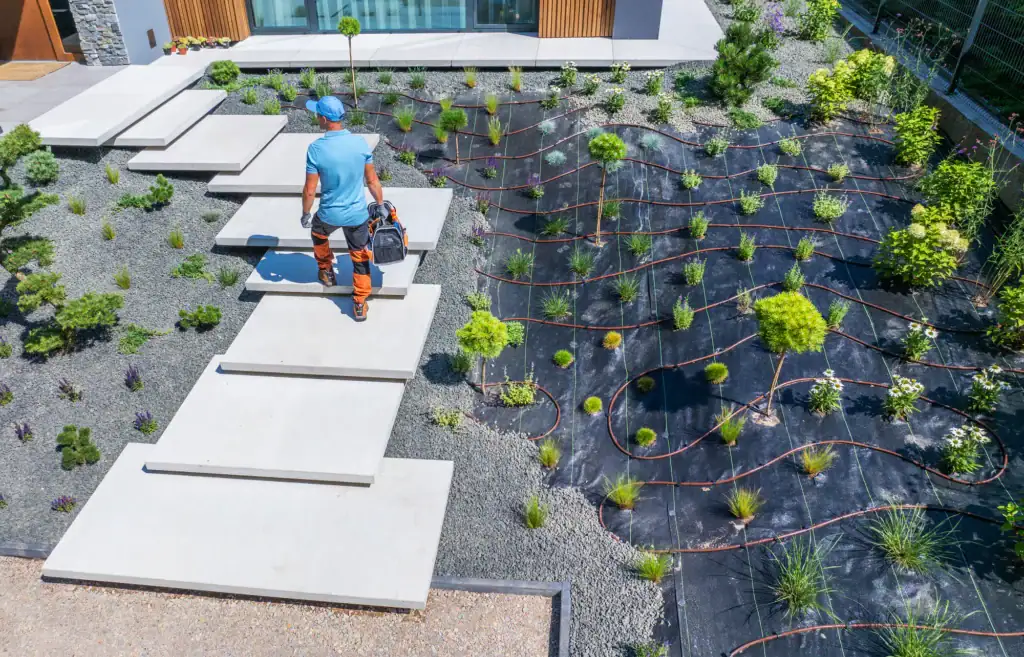
There’s a misconception worth clearing up: xeriscape doesn’t mean gravel and cactus. In the Hamptons context, a xeriscape front yard means choosing plants that are adapted to the conditions already present on your property — sandy soil, coastal exposure, limited irrigation — rather than fighting those conditions with plants that need constant water and intervention to survive.
Long Island sits above a sole-source aquifer system, meaning the entire island draws its drinking water from a single underground source. Water use is increasingly regulated across Suffolk County, and that pressure is only growing. Beyond the regulatory angle, there’s a practical one: if you’re not at the property during the week, or you rent it out during the summer, a landscape that demands intensive irrigation and maintenance is a liability, not an asset.
The good news is that a drought-tolerant, low-maintenance front yard design can be genuinely beautiful in the Hamptons — and distinctly local in character. Dune grasses, beach plum, native switchgrass, and seaside goldenrod are all plants that belong here ecologically and look exactly right against a shingle-style home. They handle salt spray, they don’t require constant irrigation once established, and most of them are naturally deer-resistant — which matters enormously in Suffolk County, where deer pressure is severe enough to eliminate entire plant categories from consideration.
For front yard design specifically, the goal is usually a combination of structure and softness: something that reads as intentional and well-kept from the street, without requiring a maintenance crew every week to look that way. Native ornamental grasses anchoring the corners of a foundation planting, beach plum filling a mid-border layer, and a ground cover of low-growing native perennials can achieve exactly that. It’s a front yard that looks like it belongs here — because the plants actually do.
Front Yard Design in the Hamptons: What the Street Sees First
In a market where properties trade at $2 million and above — and where Further Lane in East Hampton now commands more than $13 million per acre — the front yard isn’t just landscaping. It’s the first impression, the curb appeal signal, and in many cases, a meaningful driver of property value. Research consistently shows that quality landscaping increases perceived home value by 5 to 12 percent. On a $2 million Hamptons property, that’s a real number.
But front yard design in the Hamptons isn’t just about aesthetics. It’s about what survives. The privet hedges that define so many Hamptons entry sequences aren’t just traditional — they’re practical. They handle salt, they tolerate the prevailing coastal winds, and they grow dense enough to create genuine privacy. Whatever design direction you choose for the front of your property, it has to be built around what the local environment will actually support.
Southampton Front Yard Landscaping: The Formal Entry Tradition
Southampton’s front yard design language is grounded in the estate tradition. Entry allées — rows of matched trees flanking a driveway — are a signature element on larger properties. Linden, hornbeam, and pleached beech are common choices because they tolerate the conditions and create the structured, formal canopy that defines the look. The privet hedge frames the property boundary, clipped to a consistent height and profile that signals care and attention.
Foundation plantings in Southampton tend toward restraint. Boxwood in geometric arrangements, symmetrical flanking of entry doors, and a limited plant palette that emphasizes form over variety. The goal is a landscape that looks deliberately composed — not busy, not wild, and not accidental.
For homeowners with properties in the Southampton tradition, the design question is usually about scale and proportion rather than plant selection. How tall should the hedge be to provide privacy without blocking light? How wide should the allée be to feel grand without overwhelming the driveway? These are decisions that depend on the specific property, and they’re worth getting right the first time — because mature hedges and established trees take years to develop, and a poorly proportioned entry is difficult to undo.
Soil preparation matters here too. The sandy glacial soil that covers most of Southampton drains quickly, which means newly planted trees and hedges need consistent irrigation through their first two seasons to establish properly. We always integrate irrigation into the planting plan from the start, rather than adding it later — because later is usually too late for plants that struggled through their first summer without it.
East Hampton Front Yard Ideas: Where the Hamptons Aesthetic Gets More Personal
East Hampton front yards tend to allow more personality. That’s not a criticism of Southampton — it’s just a reflection of the different ownership culture. East Hampton attracts more owners who want the landscape to say something specific about the property, not just maintain a traditional standard.
That might mean a front yard anchored by a single dramatic specimen tree — a multi-stem serviceberry, a weeping beech, or a large-scale ornamental grass — rather than a symmetrical formal arrangement. It might mean a naturalistic meadow planting replacing a conventional lawn, using native grasses and wildflowers that bloom through the season and require almost no maintenance. It might mean a gravel garden with carefully selected sculptural plants that reads more like a designed space than a traditional yard.
What all of these approaches share is intentionality. The East Hampton front yard that works isn’t casual — it’s designed to look relaxed, which is different. Every plant placement, every path material, every edge treatment is a decision. The difference between a front yard that looks effortlessly beautiful and one that looks neglected is the quality of the underlying design.
Deer pressure is a real constraint in East Hampton, as it is everywhere in Suffolk County. The deer population here is significant, and any front yard planting plan that doesn’t account for it will show damage within the first season. We design around deer from the start — selecting species that deer consistently avoid, integrating fencing where necessary, and being honest with clients about which plants simply won’t survive without protection. It’s a harder conversation than presenting a beautiful plant palette, but it’s the one that saves you from replanting the same beds two years in a row.
Finding the Right Landscape Design Approach for Your Hamptons Property
Southampton and East Hampton are different markets with different design traditions, different regulatory requirements, and different expectations for what a finished landscape should look and feel like. What they share is the same unforgiving set of environmental conditions: sandy soil, salt exposure, deer pressure, and a compressed seasonal window that makes the planning timeline matter more than most homeowners realize.
The landscape projects that hold up here — season after season, without constant replanting or emergency repairs — are the ones that started with an honest assessment of the property rather than a generic plant list. Soil composition, drainage patterns, wind exposure, deer pressure: these aren’t secondary considerations. They’re the foundation.
If you’re planning a landscape project in Southampton, East Hampton, or Bridgehampton and want to talk through what makes sense for your specific property, we’ve been doing this work in Suffolk County for twenty years. Give us a call directly — we’re happy to start with a conversation before anything else.