Summary:
If you’re planning a patio in Southampton, East Hampton, or Bridgehampton, you’ve probably already gone back and forth on this. Flagstone looks beautiful but sounds expensive. Pavers seem practical but maybe too uniform for the property. And everyone you ask has a different opinion.
The truth is, both materials can work well here — and both can fail badly. What separates a patio that holds up for twenty-five years from one that starts shifting and cracking after two winters isn’t really the stone you pick. It’s whether the person installing it actually understands what the Hamptons soil, climate, and salt air do to hardscape over time.
Here’s what you actually need to know before you decide.
Flagstone Patio vs. Pavers: How They Actually Compare
At the surface level, the difference is straightforward. Flagstone is natural stone — typically bluestone, granite, or quartzite — cut or split into irregular or semi-irregular pieces. Pavers are manufactured units, usually concrete or clay, that come in uniform shapes and interlock in a predictable pattern. Flagstone costs more, takes longer to install, and requires more skilled labor. Pavers are faster to lay, easier to source, and run about 40% less in material and labor costs.
But that cost gap closes faster than most people expect when you factor in the specific conditions on the East End. Sandy glacial soil, salt air off the Atlantic and Shinnecock Bay, and somewhere between thirty and fifty freeze-thaw cycles every winter — that combination is harder on hardscape than most of the country deals with. What you pay upfront matters less than what you’re paying to repair or replace in five years.

Why Hamptons Soil Changes the Whole Conversation
The soil under most of the Hamptons is not typical topsoil. It’s glacial outwash — loose, sandy material deposited when the Laurentide Ice Sheet retreated roughly ten thousand years ago. It drains quickly, which sounds like a benefit, and it is for some things. But it also shifts, settles, and offers almost no lateral resistance. That’s the part that matters for a patio.
In most parts of the country, a standard six-inch excavation with a compacted gravel base is enough to keep a patio stable. In Southampton, East Hampton, and Bridgehampton, that’s not enough. The base needs to go eight to ten inches deep, and it needs to be compacted crushed stone — not sand, not a thin layer of gravel dropped in and called done. Without that foundation, it doesn’t matter whether you chose flagstone or pavers. The surface is going to move.
This is the detail that separates a patio that lasts from one that doesn’t, and it’s also the detail most homeowners never think to ask about. You can’t see the base once the job is finished. By the time you notice the stones shifting or the joints cracking, the damage is already done and the fix costs as much as the original installation.
There’s also the water table to think about in certain neighborhoods. Properties near Mecox Bay, Georgica Pond, or low-lying areas close to the bay can have higher groundwater levels than the surrounding area. That affects drainage planning in a specific way — and it’s something worth discussing before a single shovel goes in the ground, not after.
The point isn’t to make this sound complicated. It’s that the Hamptons has a specific set of conditions, and the right installation accounts for all of them. A contractor who’s worked here for twenty years knows what those conditions look like. One who hasn’t will treat your property like any other job.
Which Material Actually Holds Up Better Against Salt Air and Freeze-Thaw Cycles
Salt air doesn’t just affect plants and metal — it works on stone and mortar too. Porous materials absorb moisture, and when that moisture is salt-laden and the temperature drops below freezing, the expansion and contraction that happens inside the stone accelerates deterioration significantly. Over time, softer stones spall, mortar crumbles, and joints open up in ways that let water in deeper with every cycle.
The materials that perform best in this environment are dense, low-porosity stones — granite, Pennsylvania bluestone, and quartzite. These are the flagstone options we reach for on Hamptons projects because they’ve proven themselves here over years of coastal exposure. Certain sandstones and softer limestones that look similar in a showroom don’t hold up the same way once they’re living through East End winters.
For pavers, the same logic applies. Concrete pavers vary widely in density and quality. A high-density paver with a good finish will outlast a cheap one by a decade or more in this climate. The brand name on the pallet matters less than the actual specs — absorption rate, compressive strength, and whether the manufacturer tests for freeze-thaw durability.
There’s also the question of installation method. Dry-laid flagstone on a properly compacted base actually handles freeze-thaw movement well because it has some flexibility — the stones can shift slightly without cracking. Mortared flagstone on an inadequate base, on the other hand, is the worst of both worlds: rigid enough to crack, but without the structural foundation to stay put. We’ve seen plenty of patios installed that way, and they almost always fail within a few seasons. The mortar cracks, the joints open, and eventually the stones can be lifted by hand.
The right call depends on your specific property, the exposure level, and the architectural style of your home. But the material conversation always comes after the base conversation. Get the foundation right first.
Paver Patio Installation in the Hamptons: What the Process Should Look Like
A properly installed patio on the East End follows a specific sequence, and cutting any step short is how problems start. We begin with a site assessment — drainage mapping, slope evaluation, proximity to structures — before any material gets ordered or any ground gets broken. What looks like a flat, straightforward backyard in Southampton or Bridgehampton can have drainage complexity that only shows up once you start digging.
From there, excavation goes to eight to ten inches in sandy soil conditions, followed by geotextile fabric to keep the base from mixing with the native soil over time, then compacted crushed stone in multiple lifts. Drainage slope — at minimum a quarter inch per foot away from the house — gets graded precisely. Edge restraints go in to keep the base from migrating laterally. Then and only then does the stone go down.
A standard flagstone or paver patio typically takes three to five days from start to finish. Larger projects with retaining walls or outdoor kitchen integration can run one to two weeks. The timeline matters here because Memorial Day is a real deadline in the Hamptons, and we fill our spring schedules by February or March.
Hardscape Design for Hamptons Properties: Matching the Material to the Architecture
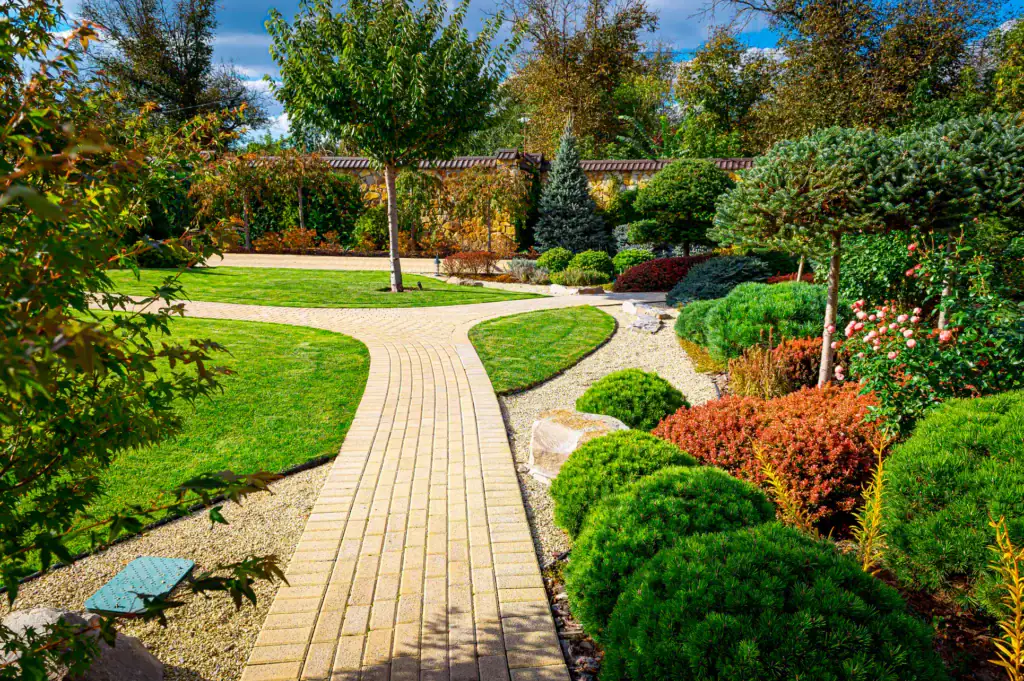
The technical side of this decision matters, but so does the aesthetic one. In a market where properties are defined by their outdoor spaces and where the architectural vocabulary is as specific as anywhere in the country, the wrong material doesn’t just underperform — it looks wrong.
Natural flagstone, especially bluestone, is the quintessential Hamptons patio material for a reason. The organic variation in color and texture complements shingle-style architecture in a way that uniform concrete pavers simply don’t. A bluestone patio enclosed by mature privet is one of the defining visual elements of a classic East Hampton or Southampton property, and it reads as intentional and considered rather than generic. If your home has that traditional Hamptons character — weathered shingles, formal garden bones, mature hedgerows — natural stone is almost always the right call aesthetically.
That said, pavers have their place here too. The newer contemporary estates in Bridgehampton and East Hampton — the ones with clean lines, glass facades, and minimal landscaping — often work better with large-format concrete pavers in a tight-jointed pattern. The geometric precision of pavers complements modern architecture in a way that irregular flagstone can undercut. This isn’t a case where one material is universally better. It’s a case where the right answer depends on what you’re working with.
Traditional farmhouses in Bridgehampton and Sagaponack tend to look best with irregular flagstone, sometimes with planted joints — creeping thyme or low moss — that soften the hardscape and connect it to the surrounding landscape. Formal estate gardens in Southampton typically call for cut Pennsylvania bluestone with mortared joints, where the precision of the stone matches the geometry of the garden design.
The hardscape design conversation is really a whole-property conversation. How does the patio connect to the pool? Where does the outdoor kitchen or fire feature sit? How does the stone relate to the walkways and driveway? Getting all of that right at the planning stage is what makes the finished project look like it belongs to the property rather than being dropped onto it.
Do You Need a Permit for a Patio in East Hampton or Southampton?
This is one of the questions we hear most often, and the answer is more nuanced than most homeowners expect. In many parts of the country, a ground-level patio doesn’t require a permit. In East Hampton and Southampton, that’s not always the case — and getting it wrong has real consequences.
Both East Hampton Town and Southampton Town regulate hardscape projects that affect impervious surface coverage or stormwater drainage. Above certain size thresholds, or if the project involves grading changes or drainage infrastructure, a permit is required. The Village of East Hampton has its own building department with requirements separate from the Town of East Hampton, which adds another layer of complexity for properties within village limits.
The reason this matters beyond simple compliance is property title. An unpermitted patio on a $2 million property in Southampton isn’t a minor issue — it’s a title defect that surfaces during the sale process and can delay or derail a transaction. We’ve seen it happen. The cost of remediation after the fact is always higher than the cost of doing it right the first time.
We handle all necessary Suffolk County permits as part of every project. That means you don’t have to navigate the East Hampton or Southampton building departments, track down the right forms, or worry about whether your project is compliant. For second-home owners who are in the city during the week and can’t manage a back-and-forth with a building department, that’s not a small thing — it’s one less problem to deal with in a process that already has plenty of moving parts.
An unlicensed contractor cannot legally pull permits in Suffolk County. If someone is offering you a significantly lower price and the permit conversation never comes up, that’s the reason why. The savings are real upfront. The exposure they create is real too.
Choosing the Right Patio Contractor in the Hamptons
The flagstone vs. pavers question has a real answer — it just depends on your property, your home’s architecture, and what you want the space to do. What doesn’t vary is how the installation needs to be done here. The base depth, the drainage planning, the material selection for coastal exposure — those aren’t optional. They’re what the Hamptons environment actually requires.
When you’re evaluating contractors, ask specifically about excavation depth. Ask how they handle drainage. Ask whether they pull permits and whether they carry a Suffolk County Home Improvement Contractor License. A contractor who can answer those questions specifically and confidently is one who’s actually done this work here. One who can’t is one who’s treating your property like any other job in any other market.
We’ve been doing this on the East End for over twenty years — one project at a time, with a one-year warranty on both labor and materials, and every permit handled from start to finish. If you’re planning a patio for this season and want to talk through what makes sense for your property, reach out to us directly at (631) 678-5629.