Summary:
If you’ve already gotten a couple of quotes and you’re not sure what to make of them, you’re not alone. Hardscape pricing in the Hamptons is all over the place — and most of what you’ll find online is written for homeowners in Ohio, not Southampton. National cost guides give you ranges that have nothing to do with East End labor rates, coastal material requirements, or the permitting process in Suffolk County. So you end up with numbers that feel useless and quotes you can’t evaluate. This page is meant to fix that. We’ll walk through what patio installation and concrete curbing actually cost here, what drives those numbers up or down, and what separates a quote that’s worth taking seriously from one that should raise questions.
Concrete Curbing Costs in the Hamptons
Concrete curbing — also called continuous concrete edging or extruded curbing — is one of those details that quietly defines how a property looks. It creates a clean, permanent border between your lawn, garden beds, and hardscape surfaces. No plastic edging that shifts after one winter. No bricks that pop out of the ground after a freeze. Just a continuous, machine-formed concrete border that holds its line for decades.
In Southampton, East Hampton, and Bridgehampton, concrete curbing typically runs $15 to $30 per linear foot installed. A standard residential project covering 150 to 300 linear feet will usually land somewhere between $2,500 and $9,000 depending on complexity, access, and the style of curbing. Properties with intricate bed shapes, tight access, or significant grade changes will sit toward the higher end. Straightforward runs along a driveway or a simple garden border will come in lower.
Landscape Curbing: What's the Difference and Which One Do You Actually Need?
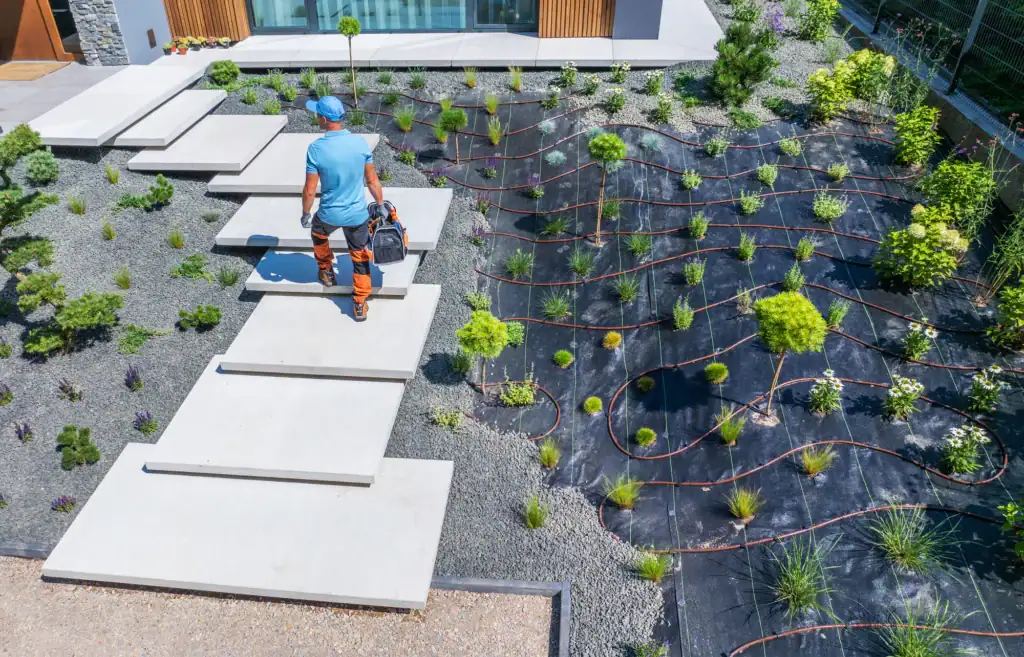
Landscape curbing is the broader category — it includes any edging system used to define the boundaries between planting areas, lawns, and hardscape. That covers everything from simple steel edging and brick borders to decorative stone and concrete. Concrete curbing is one specific type within that category, and in most cases, it’s the most durable and lowest-maintenance option available.
For Hamptons properties, concrete curbing tends to be the right call for a few reasons. The freeze-thaw cycles Long Island goes through every winter are hard on materials that aren’t continuous. Brick and paver edging can shift, heave, and separate over time as the ground moves. A machine-extruded concrete border doesn’t have joints to fail — it moves as one piece, and when it’s installed with proper base prep, it holds up remarkably well even close to the water.
The other factor is salt air. Properties within a few miles of the Atlantic or the bay are dealing with constant environmental stress that accelerates the deterioration of cheaper materials. Concrete curbing, when properly mixed and sealed, handles that exposure far better than plastic or untreated metal alternatives. It’s not the flashiest detail on a property, but it’s one of the ones that actually holds up.
Style-wise, concrete curbing comes in several profiles — mower edge, rolled edge, straight face, and various decorative options. The right choice depends on the surrounding design and how the curbing will be used. A simple mower edge along a lawn border looks clean and minimal. A more decorative profile works well framing formal garden beds around a traditional Hamptons-style home. We look at the full picture before recommending anything.
One thing worth knowing: concrete curbing is not a DIY project. The machine that extrudes continuous concrete curbing is specialized equipment, and the prep work — grading, compaction, edging layout — has to be done correctly for the curbing to stay in place. Done right, it’s a one-time installation that lasts 20 years or more. Done wrong, it cracks within a few seasons and has to come out.
Why Curbing Costs More in Southampton Than the National Average
Every national cost guide you’ll find online quotes concrete curbing at $5 to $20 per linear foot. That range is real — for markets with lower labor costs, simpler permitting, and no coastal material considerations. The Hamptons is not that market.
Labor costs on the East End are higher than most of the country. That’s just the reality of operating in one of the most expensive regions in the United States. A licensed, insured crew working in Southampton is not pricing their time the same way a crew in central Long Island would, and they shouldn’t be — the cost of doing business here is different. When you see a quote that matches the national average, it usually means something is being cut: the crew’s credentials, the material quality, or the base preparation that nobody sees but everybody eventually notices.
Suffolk County also requires home improvement contractors to carry a minimum of $500,000 in liability insurance and maintain an active license — a process that involves a written exam, insurance documentation, and workers’ compensation coverage. That’s not a small administrative hurdle. It costs money to maintain, and that cost is reflected in what licensed contractors charge. It’s also what protects you if something goes wrong on your property.
We’ve been working in Southampton, East Hampton, and Bridgehampton for over 20 years. In that time, we’ve watched plenty of cheap jobs come apart — curbing that cracked after the first hard winter, edging that shifted because the ground wasn’t properly prepared underneath. The price difference between a licensed contractor and an unlicensed one isn’t arbitrary. It reflects real differences in how the work is done and what happens to it five years later.
Patio Installation Costs in the Hamptons
A patio project in the Hamptons is a different animal than a patio project almost anywhere else in the country. The material expectations are higher, the environmental conditions are more demanding, and the properties themselves are worth enough that cutting corners doesn’t just look bad — it costs you real money when the work fails or when you go to sell.
Installed patio costs in Southampton, East Hampton, and Bridgehampton typically run $30 to $75 per square foot, depending on material, site conditions, and scope. A 400 square foot patio — which is a reasonable size for an outdoor dining and seating area — will usually land between $12,000 and $30,000 installed. Larger projects, more complex materials, or sites with significant grade changes will push that number higher.
What Material You Choose Makes the Biggest Difference in Price

Bluestone is the signature patio material of the Hamptons, and for good reason. It weathers the coastal environment gracefully, it holds up through freeze-thaw cycles, and it looks right on properties ranging from traditional Shingle Style homes to contemporary beach houses. Natural cleft bluestone — the version with the slightly irregular surface texture — is the more traditional choice and tends to cost more because each piece is unique. Thermal bluestone has a smoother, more uniform finish and is slightly more forgiving to maintain.
Flagstone, including Pennsylvania bluestone and Goshen stone, is another common choice for East End properties. It’s similar in character to bluestone but gives a more organic, irregular look that suits naturalistic landscape designs. Travertine shows up on more contemporary properties, particularly around pools. All of these are meaningfully more expensive than concrete pavers — and in most cases, they’re the right call for a Hamptons property.
Concrete pavers have their place. They’re more affordable, available in a wide range of styles, and can look excellent on the right property. But not all pavers are created equal. In a salt-air environment, cheaper pavers with calcium-based binders will spall and deteriorate within a few years. If concrete pavers are the right choice for your project, we specify products that are actually rated for coastal exposure — not whatever’s most available at the supply yard.
The base preparation is where most of the cost difference between a good job and a bad job lives, and it’s also the part you’ll never see once the project is done. A proper patio base requires excavation to 9 to 12 inches, a compacted sub-base, geotextile fabric to separate the soil from the base material, and a gravel layer that’s compacted in lifts. Skipping or shortcutting any part of that process leads to settling, cracking, and drainage problems — usually within the first two to three winters. We don’t skip it.
What Drives the Final Price Up on East End Patio Projects
Site conditions matter more than most homeowners realize when they’re getting quotes. A flat, accessible lot with no existing structures to work around is as straightforward as a patio project gets. Add a slope, and you’ve likely added a retaining wall — which can double or triple the per-square-foot cost of the project. Many Hamptons properties near the water or on elevated lots have grade changes that require real engineering, not just aesthetic decisions.
Permitting is another variable that surprises people. In Southampton and East Hampton, certain hardscape projects — particularly those above a size threshold or near wetlands, dunes, or property lines — require permits from the town building department. Properties near the water may also require review from the Trustees of the Town of East Hampton, one of the oldest governing bodies in the country, which regulates coastal land use. We handle all of that as part of the project. You don’t have to figure out which permits apply or how to file for them — that’s our job, and we’ve been doing it in these towns for two decades.
The summer deadline is also a real factor in how projects get scheduled and priced. The Hamptons has a hard seasonal rhythm. If you need a patio done before Memorial Day — whether for your own entertaining or because you’re renting the property for the summer — that timeline affects when we can schedule the work and how we plan the crew. Booking in winter or early spring is the best way to guarantee a summer-ready outdoor space without a scramble. We take one job at a time, which means when your project is scheduled, it gets our full attention from start to finish — not half our attention while we’re juggling three other sites across the East End.
On a $2 million Hamptons property, quality hardscaping can add 5 to 12 percent to the home’s value. That’s $100,000 to $240,000 in added value from a project that might cost $25,000 to $60,000. The math isn’t complicated. What makes it work is doing the project right the first time, with materials that hold up and workmanship that’s backed by a written one-year warranty on both labor and materials.
How to Choose the Right Hardscape Contractor in the Hamptons
The most important question to ask any contractor you’re considering is simple: are you licensed in Suffolk County? Not just insured — licensed. Suffolk County has its own licensing requirement, and it’s separate from New York State. If a contractor can’t give you a license number, the lower quote they’re offering comes with real risk attached. If something goes wrong on your property and they’re not licensed, your exposure is significant.
Beyond the license, look for a written warranty, a clear scope of work, and someone who actually understands the local environment — the salt air, the sandy soil, the permitting process in Southampton and East Hampton. Contractors who work all over Long Island don’t always know what survives here and what doesn’t. That knowledge comes from years of working in this specific market.
If you’re comparing quotes right now or trying to figure out whether a number you’ve received is fair, we’re happy to talk it through. We’ve been working in Southampton, East Hampton, and Bridgehampton for over 20 years, and we’re straightforward about what things cost and why. Give us a call at (631) 678-5629.