Summary:
You spent real money on that landscape. The plants looked healthy when they went in. By late summer, the ocean-facing side was brown and crispy, and by the following spring, half of it didn’t come back. If that sounds familiar, you’re not alone — and it’s not bad luck. It’s a plant selection problem. The Hamptons coastline is one of the most demanding environments you can put a plant in. Salt spray, sandy soil, relentless wind, and a deer population that treats your garden like a buffet — it all adds up. This page breaks down what actually survives here, and why, so you can stop guessing and start planning.
Understanding Long Island's Coastal Landscaping Challenges
The South Fork of Long Island sits between the Atlantic Ocean to the south and Peconic Bay to the north. That geography sounds beautiful — and it is — but it creates two distinct coastal exposures that behave very differently. Ocean-facing properties in Suffolk County deal with direct Atlantic salt spray and sustained wind. Bay-facing properties get a somewhat more sheltered environment, but saline conditions are still very much in play.
What makes Suffolk County particularly demanding is that it’s not just one problem — it’s several happening at once. The East End’s soil is glacial outwash: sandy, nutrient-poor, and fast-draining. It doesn’t hold moisture or nutrients the way inland soil does, which means plants are already working harder just to establish themselves. Add salt spray, add deer, add nor’easters from October through March, and you start to understand why so many landscapes here fail within a season or two.
How Salt Spray Actually Damages Plants — and How Far It Reaches
Most homeowners assume salt damage is a beachfront problem. It’s not. Wind-driven salt spray can travel up to 150 feet from its source, and during a strong nor’easter, that range extends considerably. If your property is within roughly an eighth of a mile of the Atlantic, you should be selecting plants specifically rated for high salt tolerance — not just anything labeled “coastal” at the nursery.
The damage mechanism matters here. Salt doesn’t just coat the leaves and cause surface burn, though that happens too. It disrupts the plant’s ability to take up water through its roots. The process is called osmosis, and when soil salinity is high enough, water actually moves out of the roots rather than in. The plant dehydrates even when there’s moisture in the ground. That’s why you can water a salt-stressed plant constantly and still watch it decline.
Foliage damage from direct spray tends to show up first on the windward side — the side facing the ocean. You’ll see browning at the leaf margins, premature leaf drop, and sometimes a clear line between the damaged windward side and the healthier leeward side. On evergreens, needles turn brown from the tip back toward the stem. On deciduous plants, the damage is often invisible until spring, when buds that were killed by winter salt spray simply don’t open. By the time you realize something went wrong, the damage happened months earlier.
This is why plant placement matters as much as plant selection. High-tolerance species need to go on the front line — the ocean-facing exposures where salt spray hits hardest. Behind them, sheltered by structures, dunes, or the windbreak the first layer creates, you have more flexibility. Moderate-tolerance species can thrive in those protected zones. Getting that layering wrong is one of the most common mistakes we see, and it’s almost always because the contractor didn’t assess the site before choosing plants.
Wind Resistant Plants That Hold Up on the East End
Wind resistance and salt tolerance often go hand in hand, and the plants that perform best on Long Island’s East End tend to have both. Beach grass — Ammophila breviligulata — is the most extreme example. It stabilizes the shifting sand dunes along the South Fork and handles direct ocean exposure that would kill almost anything else. It’s not a decorative choice, but it’s foundational for any ocean-facing property that needs to hold soil and create a buffer.
Bayberry is one of the most underused plants in Hamptons landscaping. It’s native to Long Island, tolerates wind and direct salt spray, works as a hedge or a mass planting, and requires almost no maintenance once established. Beach plum is another native that’s genuinely built for this environment — it evolved in sandy dunes and salty air, and it shows. Eastern red cedar gives you an evergreen windbreak option that holds up through hard winters and doesn’t look beaten down by March.
For properties that want something with more visual appeal, rosa rugosa is the beach rose you see lining properties from Southampton to Montauk. It’s tough, fragrant, and handles salt spray well. Seaside goldenrod blooms along East End roadsides every September — it’s native, deer resistant, and thrives in exactly the conditions that kill more delicate plants. Hydrangeas are possible too, but they belong in sheltered zones, not on the ocean-facing front line. Put them in a protected spot with good soil amendment and they’ll thrive. Put them directly in the salt spray corridor and they won’t last a season.
The deer factor is real and it’s specific to Suffolk County. White-tailed deer are endemic here, and they’ll eat a surprising number of otherwise appropriate coastal plants. Selecting species that are both salt tolerant and deer resistant narrows the list, but it doesn’t make it impossible. Bayberry, beach grass, eastern red cedar, seaside goldenrod, and rosa rugosa all hold up reasonably well against deer pressure. It’s one more reason why generic plant lists from national gardening sites don’t translate cleanly to the East End — they’re not accounting for the full picture.
Coastal Landscaping Design: What Changes When You're Near the Ocean
Designing a landscape for a beachfront or near-ocean property in Suffolk County isn’t just about swapping in tougher plants. The whole approach changes. Site assessment comes first — evaluating which direction the prevailing winds come from, how close the property is to the water, where dunes or structures create natural shelter, and what the soil profile looks like before anything gets planted.
Sandy coastal soil drains fast. That’s good for preventing root rot, but it means nutrients and moisture don’t stay available long enough for many plants to establish well. Amending with organic matter before planting is standard practice for any serious coastal installation, and it makes a measurable difference in how plants perform through their first season and beyond.
Soil and Irrigation Considerations for Sandy Coastal Properties
The glacial outwash soil that covers Long Island’s East End is sandy by nature. It drains quickly, holds little organic matter, and doesn’t buffer plants against stress the way heavier inland soils do. Before planting anything, that soil needs to be assessed and amended. Adding organic matter improves water retention, increases nutrient availability, and gives roots something to hold onto during establishment. It’s not glamorous, but it’s the difference between a landscape that makes it through its first summer and one that doesn’t.
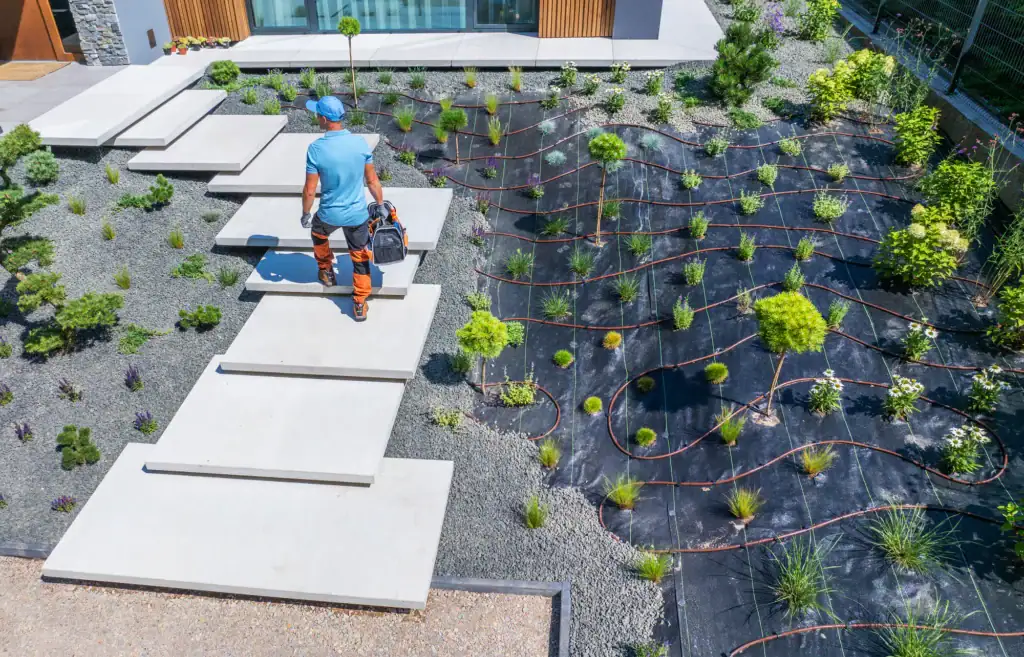
Irrigation design for coastal properties is its own conversation. Standard sprinkler programming doesn’t account for how fast sandy soil drains, so systems either run too short to reach deep roots or run long enough to waterlog the surface. Neither is good. Drip irrigation and root-zone watering are better choices near ocean-facing plantings for another reason too — overhead spray near the coast can actually push more salt onto foliage, compounding the damage you’re trying to prevent. Targeted, low-volume watering keeps moisture where the roots are without coating the leaves.
Suffolk County draws its water supply entirely from the Long Island Aquifer — a sole-source system with real capacity limits. Water use restrictions apply during summer months, and they’re not optional. An irrigation system designed for this environment should be built around efficiency from the start, not patched for compliance after the fact. Drought-tolerant, salt-tolerant plants reduce irrigation demand naturally, which matters both for compliance and for your water bill. The two goals — right plant selection and right irrigation design — reinforce each other when they’re planned together.
What to Do After a Nor'easter Damages Your Coastal Plantings
Nor’easters are the dominant storm event on the South Fork, and they happen multiple times between October and March. A strong one brings sustained wind, heavy salt spray, and sometimes storm surge — and the damage it leaves behind isn’t always obvious right away. The windward side of shrubs and trees may show a clear “salt shadow” pattern, where everything facing the ocean is scorched and the leeward side looks untouched. Evergreens brown from the tips back. Deciduous plants may look fine until spring, when buds that were killed by the salt exposure simply fail to open.
The first step after a significant storm is a walk-through to identify which plants took the worst of it. Rinsing salt off foliage with fresh water — if done quickly after a storm — can reduce the damage before it sets in. For plants that are already showing stress, the instinct to fertilize heavily is usually the wrong call. Salt-stressed plants are often further harmed by aggressive fertilization. A slower, more careful recovery approach tends to produce better results.
What matters more than post-storm reaction is pre-storm preparation. A landscape that was designed with the right species in the right zones, with a proper windbreak layer on the ocean-facing side, will take a nor’easter significantly better than one that wasn’t. The plants on the front line — beach grass, eastern red cedar, bayberry, beach plum — absorb the worst of the exposure and protect what’s behind them. That’s not an accident; it’s the point of the design. When we assess a coastal property before planting, we’re thinking about what happens in February, not just what looks good in July.
Properties in Amagansett, Montauk, and along the ocean-facing corridors of Southampton and East Hampton see this play out every winter. The landscapes that hold up are the ones that were built for it from the start, with species and placement that account for what this coastline actually does.
Finding a Coastal Landscaping Contractor Who Actually Knows Suffolk County
The plants matter. The soil prep matters. The irrigation design matters. But none of it works if the person putting it together doesn’t understand what they’re working with. Most landscaping failures on Long Island’s East End come down to generic approaches applied to a very specific environment — wrong plants, wrong placement, no accounting for salt spray zones or sandy soil or the deer that will eat half of it by June.
Suffolk County requires a Home Improvement Contractors license with a written exam — not just a business registration. That requirement exists for a reason, and it’s worth asking about before anyone breaks ground on your property. A licensed contractor with real coastal experience will assess your site before recommending a single plant. They’ll think about wind direction, proximity to the water, soil condition, and how the irrigation system will interact with all of it.
We’ve been working on coastal properties in Southampton, Bridgehampton, East Hampton, Amagansett, and Montauk for over 20 years. If you’re ready to stop replacing plants every season and want a landscape that holds up, give us a call at (631) 678-5629. We’re available Monday through Friday, 9:00am to 5:00pm, and we’re happy to take a look at what you’re working with.