Summary:
If you own property in Southampton, East Hampton, or anywhere along the East End, you already know your backyard isn’t a simple project. The soil drains differently. The deer eat everything. Salt air off the water kills plants that would thrive ten miles inland. And if your drainage isn’t right from the start, a nor’easter will remind you quickly.
This page is for homeowners who want to get the design right the first time — not fix it two seasons later. We’ll cover what works in coastal Suffolk County conditions, what to watch out for when hiring, and what a well-planned backyard project actually looks like from the ground up.
Backyard Design on Coastal Long Island: What's Different Here
The Hamptons market has no shortage of contractors willing to take your money and install whatever looks good in a catalog. The problem is that catalog thinking fails fast on the East End. What works in Connecticut or even Nassau County doesn’t automatically translate to coastal Suffolk County, and the gap between a good-looking installation and one that actually lasts comes down to understanding the specific conditions your property sits in.
Suffolk County alone has ten different soil associations, each with distinct drainage patterns and pH levels. Coastal areas around Southampton and Bridgehampton are dominated by sandy outwash soils — the legacy of glacial deposits — that drain so quickly they can starve roots of moisture while simultaneously making irrigation design more complicated. Long Island soils also tend to run acidic, which means most landscape plants need pH adjustment just to establish properly. Skip that step and you’re planting in conditions that work against you from day one.
How Sandy Soil, Salt Air, and Deer Pressure Shape Every Design Decision
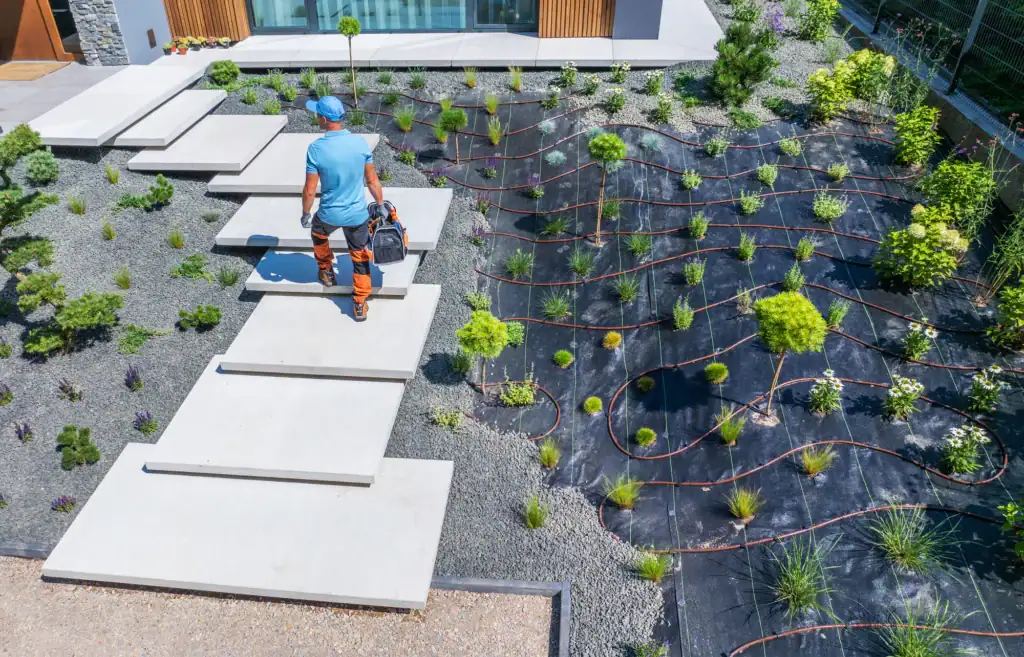
Salt exposure is one of the most underestimated factors in East End landscape design. Properties within a mile or two of the ocean or bay deal with salt spray that damages conventional landscape plants — sometimes visibly, sometimes slowly over a season or two. The fix isn’t to avoid planting near the water. It’s to select species that are actually built for these conditions: rugosa rose, bayberry, inkberry, serviceberry, beach grass, and native ornamental grasses that have spent centuries adapting to exactly this environment. A contractor who doesn’t know the difference between a salt-tolerant plant and a catalog favorite is going to cost you money in replanting.
Then there’s the deer situation. The East End has one of the highest white-tailed deer densities in the country. This isn’t a minor nuisance — it’s a fundamental design constraint. Any planting plan that doesn’t account for deer browse will be eaten, sometimes within weeks of installation. Designing around it means selecting deer-resistant species and, where needed, integrating physical barriers that don’t ruin the aesthetic of the property.
Hardscape decisions are equally affected by local conditions. Long Island winters produce significant freeze-thaw cycling, and patios or driveways installed without proper base preparation — the right excavation depth, compacted stone base laid in lifts — will crack and heave after the first hard winter. This is one of the most common and most avoidable failures we see on properties that were worked on by contractors who cut corners on what’s underground. The finished surface looks fine on day one. By spring, the problems show up.
Drainage connects all of it. Sandy soil drains fast, but coastal areas near bays and inlets can have surprisingly shallow water tables. A low-lying section of your yard that looks perfectly level can become a soggy mess after a storm if drainage wasn’t designed in from the start. Retrofitting drainage after hardscape and planting are already in place is significantly more disruptive and expensive than addressing it during the initial design phase. Every backyard project we take on in this area starts with a drainage and soil assessment — not because it’s a nice extra, but because everything else depends on it.
Planning a Backyard in the Hamptons: What the Season Demands
The Hamptons has a compressed use window that shapes how backyard projects need to be planned. Most properties are most actively used between Memorial Day and Labor Day. That means if you want your outdoor space ready for summer, the conversation needs to start in February or March at the latest — not April, when the scheduling crunch is already setting in.
This is especially true for second-home owners who aren’t on the property year-round. A lot of Hamptons homeowners are managing this from the city, which means they need a contractor who can handle the project without constant supervision, communicate proactively, and deal with permits and inspections without the homeowner needing to drive out for every step. That’s how we operate.
The permit side of things is worth understanding before you hire anyone. In Suffolk County, landscaping and construction work on residential properties requires a Home Improvement Contractor license at the county level — and on the East End, individual towns like Southampton and East Hampton require their own separate licensing on top of that. Under Suffolk County Code §563-21, any landscaper performing work on your property is legally required to provide a written contract specifying scope, timeline, and costs before starting. Many operators skip this. Some don’t hold the required licenses at all, which leaves the homeowner — not the contractor — exposed to permit violations, stop-work orders, and fines with no warranty recourse.
We’ve been working specifically in coastal Suffolk County for over 20 years. That’s not a general contractor background that happens to include a few Hamptons projects. It’s two decades of working in Bridgehampton silt loam and Haven loam, designing around deer pressure and salt spray, pulling permits through Southampton Town and East Hampton Town, and building outdoor spaces that still look right five years after installation.
How to Choose a Landscaping Contractor in Suffolk County
Choosing a contractor in this market is harder than it looks. The price range between quotes can be dramatic, and without a clear framework for what drives those differences, it’s easy to make a decision you regret. The gap between a licensed, insured contractor with a written warranty and an unlicensed operator isn’t just about paperwork — it’s about base preparation, material quality, permit costs, and whether anyone shows up to fix something if it fails.
The questions worth asking before you commit: Are you licensed in Suffolk County and in the specific town where my property is located? Do you carry general liability and workers’ compensation insurance? What does your warranty actually cover, and for how long? Will you handle the permits, or is that on me?
What a Licensed Landscaping Contractor in Suffolk County Actually Means

Licensing in Suffolk County isn’t just a formality. The county’s Home Improvement Contractor license requires a written examination and proof of current insurance — minimum $500,000 in general liability coverage, with workers’ compensation required for any business with employees. Contractors who don’t hold this license are operating illegally on residential properties, and the penalties for unlicensed work can include thousands of dollars in fines and exposure to criminal liability. More importantly for you as a homeowner, unpermitted work can create problems at resale and leave you with no legal recourse if the work fails.
Beyond the county license, East End towns have their own requirements. A contractor who is county-licensed but not registered with Southampton Town or East Hampton Town is still not in full compliance for work on your property. This dual-licensing requirement is not widely known, which is exactly why so many homeowners end up hiring operators who don’t meet it.
We carry full licensing and insurance for the communities we serve — Southampton, East Hampton, Bridgehampton, Amagansett, Montauk, and West Hampton Dunes. We pull all required permits before any work begins, manage the submission and inspection process, and provide you with copies of everything. You don’t need to make a trip to town hall. That’s part of what a licensed contractor actually does.
The warranty question matters just as much. We back every project with a one-year warranty covering both labor and materials. If something fails because of our workmanship or the materials we used, we come back and fix it at no charge. That’s a specific, written commitment — not a vague promise to “stand behind our work.” In a market full of operators who disappear after the final invoice, it’s a meaningful distinction.
FAQs: Landscaping Contractors and Backyard Design in Suffolk County, NY
What plants actually survive in coastal Long Island soil and salt air? The species that hold up best in coastal Suffolk County conditions are ones that evolved here or in similar environments. Rugosa rose, bayberry, inkberry, serviceberry, beach grass, and native ornamental grasses are reliable choices near the water. Further from the shoreline, the palette opens up, but deer pressure remains a factor almost everywhere on the East End. The right plant selection starts with knowing your specific soil type, your distance from the water, and your sun and shade patterns — not just what’s available at a nursery. We assess these conditions on every property we work on in Suffolk County before recommending a single plant.
Do I need a permit for backyard landscaping in Southampton or East Hampton? It depends on the scope of work. Basic planting generally doesn’t require a permit. Hardscape projects — patios, retaining walls, driveways — typically do, especially if they affect drainage or are near wetlands. Any work near a wetland buffer in coastal Suffolk County may also require environmental review. We handle the permit process for every project we take on, which means we assess what’s required before we start, not after.
How much does backyard landscaping cost on Long Island? The range is wide, and the reason quotes vary so dramatically usually comes down to what’s included — or not. Base preparation for hardscape, permit fees, licensed labor, proper drainage integration, and warranty coverage all add to the cost of a legitimate project. A quote that’s half the price of others is usually skipping one or more of those. The “savings” tend to show up as repair costs within a season or two.
When should I start planning a backyard project in the Hamptons? If you want work completed before summer, February or March is when the planning conversation should start. The scheduling window for quality contractors on the East End fills up fast, and projects that require permits need lead time for submission and approval. Waiting until April or May for a summer-ready outdoor space is usually too late.
What’s the difference between a licensed and unlicensed landscaping contractor in Suffolk County? A licensed contractor in Suffolk County has passed a written examination, carries verifiable insurance, and is legally authorized to perform residential work in the county. An unlicensed operator has none of those things — and if something goes wrong, the legal exposure lands on the homeowner. In Suffolk County, hiring an unlicensed contractor for permitted work can result in stop-work orders, fines, and difficulty selling the property later. We maintain full licensing in every town where we work throughout the county.
Can one contractor handle landscaping, drainage, masonry, and irrigation as a single project? Yes — and it’s worth finding one who can. When those systems are designed and installed by separate trades, you often end up with irrigation that fights your drainage, or hardscape that undermines your grading. We handle all of it as one integrated scope, which means the drainage is designed before the patio goes in, and the irrigation is calibrated to the actual soil conditions on your property.
Ready to Start Planning Your Coastal Long Island Backyard?
Getting a backyard right on the East End takes more than a good eye for design. It takes someone who understands what the soil does here, what the deer will eat, what a nor’easter can expose, and what the permit process actually requires. The difference between a backyard that holds up and one that needs to be redone in two years usually comes down to decisions made before the first plant goes in the ground.
If you’re planning a project in Southampton, East Hampton, Bridgehampton, or anywhere in coastal Suffolk County, the best time to start the conversation is before you’ve committed to anything. A site assessment tells you what your property actually needs — not what looks good in a design portfolio.
We’ve been doing this work on the East End for over 20 years. One project at a time, fully licensed, with a one-year warranty on everything we touch. Give us a call at (631) 678-5629 — we’re available Monday through Friday, 9:00am to 5:00pm, and we’re based right here in Southampton at 396 N Main St.