Summary:
Most homeowners start thinking about a new driveway the same way — they notice a crack, or a heave, or they’re finally doing the full property renovation they’ve been putting off. Then they go looking for answers and find a lot of generic content that doesn’t account for salt air, sandy glacial soil, or the fact that East Hampton has specific subbase requirements that most out-of-area contractors have never heard of.
This guide is written for homeowners in Southampton, East Hampton, and Bridgehampton who want straight answers before they start making calls. We’ll cover materials, permits, costs, and the questions we hear most often — so you can walk into this process informed.
Driveway Design Options for Hamptons Properties
The Hamptons market has its own material preferences, and they exist for good reasons. Bluestone, Belgian block, and interlocking pavers dominate the area because they hold up against coastal conditions and they look right alongside the architecture here. Asphalt and basic concrete aren’t wrong choices — but they’re less common in Southampton and East Hampton precisely because the salt air and freeze-thaw cycles are harder on them than they are on natural stone and quality pavers.
The other factor is design coherence. A driveway in Bridgehampton isn’t just a place to park — it’s the first thing anyone sees when they arrive. In a market where property values run well into the millions, a driveway that clashes with the surrounding landscape is a visible problem, not just an aesthetic one.
Which Driveway Material Holds Up Best in Coastal Suffolk County?
This is the question we get asked more than any other, and the honest answer is: it depends on what you’re optimizing for. But we can give you a useful framework.
Interlocking pavers are the most popular choice for Hamptons driveways, and the reason comes down to how they handle stress. Unlike a solid concrete slab, pavers flex slightly with ground movement. Suffolk County’s sandy glacial soil shifts — especially near the water — and a rigid surface will crack under that pressure over time. Individual pavers can also be replaced without disturbing the whole surface, which matters when you’re 15 years into a driveway that’s otherwise in great shape.
Bluestone is the prestige option. It’s dense, durable, and handles salt air exceptionally well. It’s also heavier and more expensive to install correctly, which is why you’ll see it on higher-end properties in East Hampton and Southampton where the investment makes sense relative to the property value. When it’s installed on a proper base, a bluestone driveway can last decades without significant maintenance.
Belgian block — the classic cobblestone style — is another material that’s held its place in the Hamptons market for a long time. It’s extremely durable, it drains naturally between the joints, and it has a timeless look that doesn’t date. The downside is that it can be rough underfoot and isn’t ideal for every property style.
Concrete is worth mentioning because it’s often the first thing people consider. It can work well here, but Long Island’s freeze-thaw cycles put real stress on concrete slabs, and once a concrete driveway cracks, repairs are visible. If you go with concrete, the base preparation has to be done right — East Hampton’s own requirements call for a minimum six-inch stabilized subbase and four inches of compacted aggregate base, and that’s a floor, not a ceiling.
Asphalt is the most affordable upfront, running roughly $3–$5 per square foot installed, but it needs resealing every three to five years and resurfacing every 15–20 years. In the Hamptons market, where the labor and material costs of ongoing maintenance add up quickly, the lifetime cost calculation often favors pavers despite the higher initial investment.
Why Subbase Preparation Makes or Breaks a Driveway in the Hamptons
This is the part of driveway installation that’s completely invisible once the job is done — and it’s the part that determines whether your driveway looks the same in year ten as it did in year one.
Suffolk County’s soil is predominantly sandy, which sounds like it should drain well. And it does, in some areas. But sandy soil also shifts, settles unevenly, and doesn’t provide a stable load-bearing surface on its own. For paver installations in particular, the industry standard for this region calls for excavation to at least eight to ten inches, followed by a compacted gravel base, a layer of bedding sand, and properly set edge restraints to keep everything locked in place.
Contractors who skip steps here — who excavate four inches instead of eight, or skip the compacted gravel layer to save time — are creating a driveway that will start showing problems within a few seasons. You’ll see pavers shifting, edges separating, and low spots forming where water pools. By the time it’s visible, the fix usually involves tearing out and redoing the base entirely.
The salt air factor is real too. Coastal properties within a few miles of the Atlantic or the Peconic Bay are exposed to salt-laden air year-round, which accelerates deterioration in materials that weren’t selected or sealed for that environment. This is why material selection and base preparation aren’t two separate conversations — they’re the same conversation. A properly specified paver installed on a properly prepared base in coastal Suffolk County will outlast a poorly specified material installed on a marginal base by 20 years or more.
We’ve been working on driveways and hardscape projects in Southampton, East Hampton, and Bridgehampton for nearly 20 years. The difference between the projects that hold up and the ones that don’t almost always comes back to what’s underneath — not what’s on top.
Hardscape Design: Where Your Driveway Fits the Bigger Picture
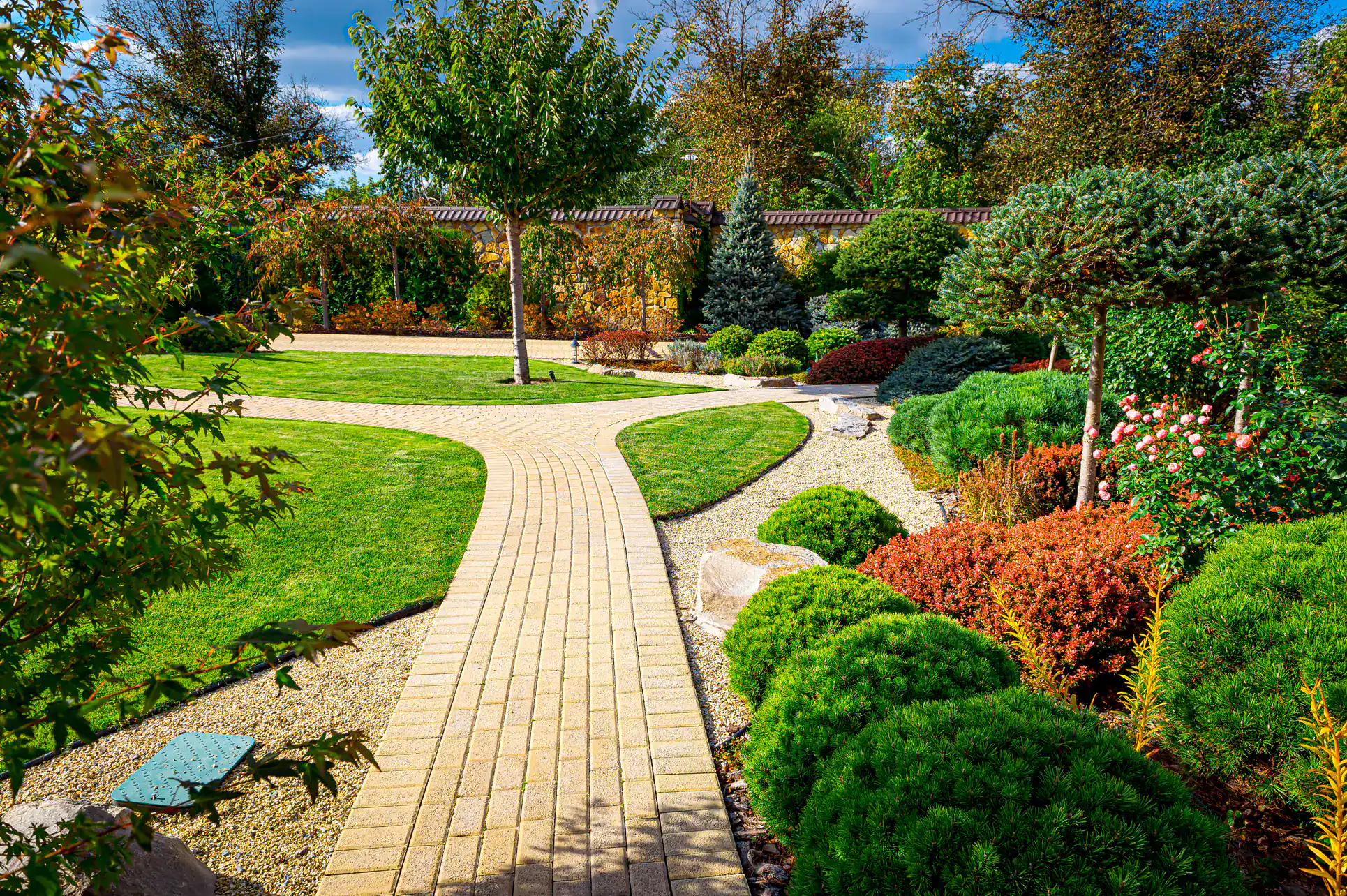
A driveway is a hardscape element — and hardscape design is the practice of planning how all your hard surfaces work together. That includes your driveway, walkways, entry features, patios, retaining walls, and any other paved or structural elements on the property.
This matters because a driveway that was designed in isolation from the rest of the property often looks like it. When the material, scale, and style of your driveway don’t connect to the walkways, the entry, or the surrounding landscape, you end up with a property that feels assembled rather than designed. In the Hamptons, where the outdoor living space is a genuine extension of the home, that disconnect is noticeable.
Do I Need a Permit to Replace My Driveway in East Hampton or Southampton?
This is one of the most common misconceptions we run into. Homeowners assume that replacing a driveway — especially if it’s roughly the same size and footprint — doesn’t require a permit. In most cases in East Hampton and Southampton, that assumption is wrong, and it creates real problems down the line.
East Hampton requires permits for new driveway construction and major replacements. Southampton Town has its own permitting requirements, setback rules, and impervious surface coverage limits that vary by zoning district. If your driveway connects to a county road, you’ll also need a highway work permit from the Suffolk County Department of Public Works. And if your property is near a wetland or coastal zone — which describes a significant portion of properties in this area — there may be additional review required through the New York State Department of Environmental Conservation.
The permit process exists for good reasons. Drainage regulations prevent runoff problems that affect neighboring properties. Setback requirements protect natural buffers. Impervious surface limits exist specifically because coastal Suffolk County has serious stormwater management concerns — excess runoff into the bay and ocean is a documented environmental issue, and municipalities take it seriously.
Skipping permits isn’t just a technical violation. It creates title issues at resale, means the work can’t be legally inspected or certified, and can result in a stop-work order that halts your project mid-installation. We handle all necessary Suffolk County permits on every project we take on — it’s part of the job, not an add-on — because homeowners shouldn’t have to navigate that process on their own.
One more thing worth knowing: Suffolk County requires proof of liability insurance as part of the permit process for residential driveway work. That’s one of several reasons why hiring an unlicensed contractor for this type of project isn’t just a quality risk — it’s a legal one.
Does a New Driveway Actually Increase Your Home's Value in the Hamptons?
The short answer is yes — meaningfully so, especially in this market.
In the Hamptons, the calculus is different than national averages. Property values in Southampton and East Hampton regularly run $1.5 million and above, with luxury properties well beyond that. A 5–10% value increase on a $2 million property is $100,000–$200,000. More importantly, in a market where buyers are making decisions based heavily on how a property presents — and where a dated or failing driveway signals deferred maintenance throughout — the cost of not investing in your driveway is real.
The National Association of Realtors has documented that overall landscape upgrades can recoup close to 100% of their value. A well-executed driveway that’s integrated into a cohesive hardscape design — not just a slab dropped in front of the garage — contributes to that return because it reads as intentional, well-maintained, and appropriate to the property.
What doesn’t add value is a driveway that was installed cheaply, permitted improperly, or built on a marginal base that’s already showing stress. Buyers in this market have seen enough properties to know the difference between a driveway that was done right and one that’s holding together for now. The condition of your driveway tells a story about how the rest of the property has been maintained — and buyers factor that in.
Every project we complete comes with a 1-year warranty on both labor and materials. That’s not a marketing line — it’s documentation we provide at project completion, because we stand behind the work and we want you to have that protection in writing.
Choosing the Right Driveway Contractor in Southampton, East Hampton, or Bridgehampton
The Hamptons market has no shortage of contractors. What it has a shortage of is contractors who are licensed in Suffolk County, carry proper insurance, understand the local permit requirements, and have the kind of track record that comes from nearly two decades of working on properties in this specific area.
When you’re evaluating contractors, ask to see their Suffolk County Home Improvement Contractor license. Ask who pulls the permits. Ask what their base preparation process looks like for sandy coastal soil. The answers will tell you a lot.
If you’re planning a driveway project in Southampton, East Hampton, or Bridgehampton and want to talk through your options before committing to anything, we’re a straightforward call. No pressure, no vague estimates — just a conversation with people who know this market and can tell you exactly what your project involves.