Summary:
If you’ve been dragging hoses around your Southampton lawn every summer morning, or watching brown patches spread despite your best effort, you already know manual watering doesn’t cut it on a Long Island property. The issue usually isn’t how much water you’re putting down — it’s where it’s going and how consistently it’s getting there. A professionally designed sprinkler system solves both problems. But in Suffolk County, the design has to account for things a generic installation simply won’t — sandy glacial soil, coastal salt air, freeze-thaw winters, and local water regulations that catch unprepared contractors off guard. Here’s what that actually looks like in practice.
How Sprinkler System Installation Works on Long Island's Coastal Properties
Most sprinkler system installations follow the same general sequence — site assessment, zone design, trenching, pipe and head installation, controller setup, and a final walkthrough. But on Long Island, each of those steps carries details that matter more than they would in a standard suburban lot elsewhere.
The soil here is the first factor. Suffolk County’s sandy, fast-draining soil — a direct result of glacial deposits — doesn’t hold moisture the way clay-heavy soils do. That means irrigation zones need to run shorter, more frequent cycles to keep water in the root zone rather than letting it drain straight through. A system designed for generic conditions will leave your lawn looking dry even when the timer is running on schedule.
Salt air is the second factor most contractors underestimate. Properties within a few miles of the Atlantic or Peconic Bay deal with year-round salt exposure that degrades standard irrigation components faster than most people expect. We use components rated for that environment — not whatever ships cheapest from a supply house.
What Proper Zone Design Looks Like for a Suffolk County Lawn
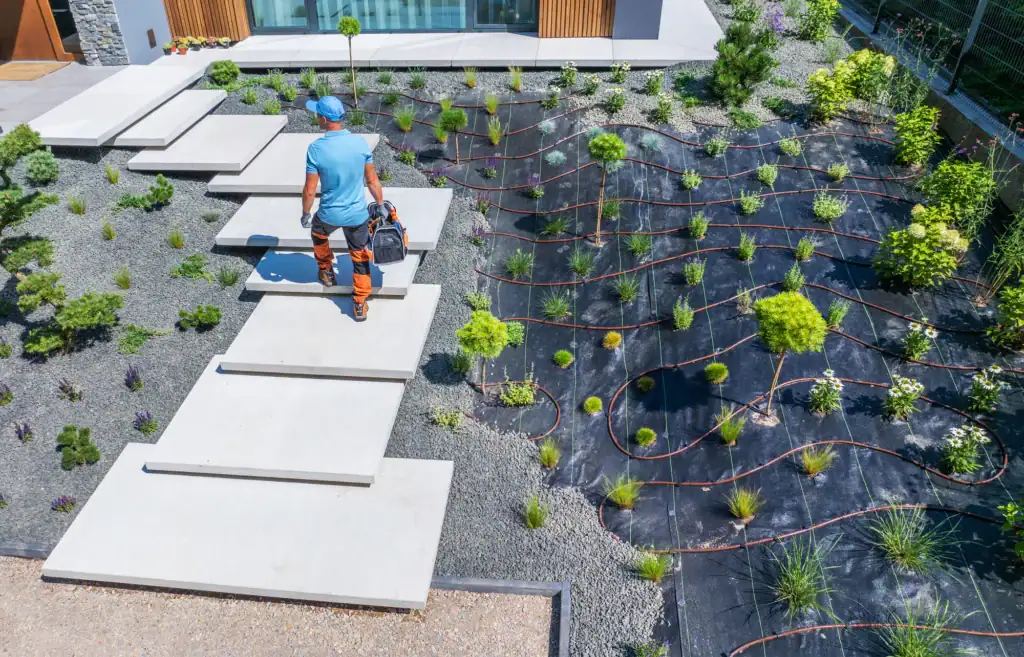
Zone design is where a good installation separates itself from a mediocre one. The basic principle is straightforward — group areas with similar water needs together, and size each zone so the system’s water pressure can cover it evenly. In practice, that means your turf areas, shrub beds, and garden sections should each run on separate zones with their own timing and output settings.
For Suffolk County properties, this gets more specific. Sandy soil drains quickly, so turf zones typically need shorter run times applied more frequently — sometimes two or three short cycles per day during peak summer heat rather than one long soak. Shrub and perennial beds, on the other hand, often do better with deeper, less frequent watering that encourages root depth. Mixing those on the same zone is one of the most common mistakes in residential irrigation, and it’s one of the first things we look for when assessing an existing system.
Head placement matters just as much as zone timing. The professional standard is head-to-head coverage, meaning each sprinkler head’s spray pattern overlaps with the adjacent head. Large rotary heads are typically spaced 25 to 40 feet apart; smaller fixed-spray heads closer to 8 to 17 feet. When heads are spaced too far apart — which happens when a contractor is trying to use fewer heads to cut costs — you get dry strips between them that no amount of run-time adjustment will fix.
Water pressure also shapes the design from the start. Every system has a maximum flow rate it can handle, and a proper installation starts with measuring your actual water pressure and flow before a single head location is drawn. Skipping that step leads to zones that either underperform because there isn’t enough pressure to drive them, or ones that mist and drift because the pressure is too high for the heads specified.
One more thing worth knowing: New York State requires a backflow prevention device on any residential irrigation system connected to the public water supply. In Suffolk County specifically, a 2012 regulation requires that backflow testing be performed by a licensed Master Plumber. An unlicensed contractor can’t legally complete this step — which means you could end up with a system that’s out of compliance before the first season is over.
Why Winterization Is Non-Negotiable for Long Island Irrigation Systems
Long Island winters aren’t as brutal as upstate New York, but they’re cold enough to crack irrigation pipes and damage sprinkler heads if water is left sitting in the lines when temperatures drop. Winterization — typically done by blowing compressed air through each zone to force out any remaining water — is something every Suffolk County homeowner with an in-ground system needs to schedule every fall without exception.
The cost is manageable, typically running between $50 and $230 depending on the size of the system and the number of zones. What it prevents is far more expensive. A cracked lateral pipe buried a foot underground, or a valve body that’s split from freezing, can easily run into hundreds of dollars to diagnose and repair — and if it goes unnoticed until spring startup, you may be dealing with water damage to surrounding landscaping before you even realize there’s a problem.
For seasonal property owners — and there are many in the Hamptons and East End communities who use their properties primarily from Memorial Day through Labor Day — this is especially important. If you’re not on-site through the fall and winter, you need a contractor you trust to handle winterization on schedule, not one you have to chase down every October. The same goes for spring startup, which involves checking each zone for proper operation, adjusting head positions that may have shifted over the winter, and confirming the controller is programmed correctly for the season ahead.
A well-maintained system, properly winterized every year and inspected annually, can last well over 20 years. Neglect that maintenance, and you’re looking at repairs and partial replacements within five to seven years. The math is straightforward — regular maintenance is far cheaper than reactive repairs, and in a market where landscaping investments routinely run into the tens of thousands of dollars, protecting the system that keeps that investment alive makes sense.
Proper French Drain Integration With Your Sprinkler System on Long Island
Here’s something most irrigation contractors won’t bring up: a sprinkler system and a French drain aren’t competing solutions — they’re complementary ones. Irrigation manages how water gets to your lawn. Drainage manages where it goes when there’s too much of it. On Long Island’s sandy, fast-draining soil, that distinction matters more than it might seem.
Sandy soil drains quickly under normal conditions, which is why irrigation needs to be more frequent here than in other markets. But when you add heavy rainfall on top of an active irrigation schedule, or when a property has low spots, compacted areas, or grading that directs runoff toward the house, that fast-draining soil isn’t always fast enough. Water pools, saturates the root zone, and creates exactly the kind of soggy conditions that kill grass and rot landscaping roots.
A French drain placed strategically on a property — particularly in low areas or along the edges of irrigated zones — moves that excess water away before it becomes a problem. We handle both systems, which means the design accounts for how they interact rather than treating them as two separate projects that happen to be on the same property.
Cost of French Drain in Your Yard: What Suffolk County Homeowners Should Budget

French drain costs vary based on the scope of the project — how much linear footage is needed, how deep the trench has to go, what the outlet situation looks like, and whether the area is easily accessible or requires working around established landscaping and hardscaping. Nationally, installed French drains typically run between $10 and $50 per linear foot, with full yard drainage systems ranging from roughly $1,500 on the low end to $18,000 or more for larger, more complex properties.
For Hamptons and East End properties in Suffolk County, where lots tend to be larger and landscaping more established, it’s reasonable to plan for the middle to upper end of that range for anything beyond a simple perimeter drain. The presence of mature plantings, existing hardscaping like patios or driveways, and the need to tie into a proper outlet all add to the scope. That said, Long Island’s sandy soil does simplify some aspects of the work — it’s easier to trench through than dense clay, which can reduce labor time in some situations.
What drives cost more than anything else is getting the design right from the start. A French drain that’s installed at the wrong slope, without proper filter fabric around the perforated pipe, or without a well-designed outlet, will clog and fail within a few years. At that point you’re paying to have it dug up and redone — which costs significantly more than doing it correctly the first time. When we assess a property for drainage, we’re looking at the full picture: where water is coming from, where it needs to go, and how the irrigation system interacts with those patterns. That conversation doesn’t cost anything extra — it’s just part of how we approach the work.
The best time to address drainage is before or during a sprinkler installation, not after. Adding a French drain after an irrigation system is already in place means working around buried pipe and heads, which adds complexity and cost. When both systems are planned together, the design is cleaner and the result is a property that manages water effectively in every direction.
French Drain Cost Per Linear Foot: What the Numbers Actually Mean
The per-linear-foot pricing model for French drains is useful as a starting point, but it can be misleading if you’re trying to compare quotes without understanding what’s included. At the lower end of the $10 to $50 range, you’re typically looking at a shallow trench, basic perforated pipe, and minimal filter fabric — work that might be appropriate for a small, simple drainage problem but won’t hold up on a larger property or one with significant water volume moving through it.
A properly installed French drain at a depth appropriate for Long Island conditions — typically 18 to 24 inches for residential applications, deeper in some cases — with quality perforated pipe, non-woven filter fabric wrapped around the pipe and gravel, and a properly graded outlet, will land toward the middle or upper end of that range. That’s not a markup — that’s the cost of doing it in a way that actually works for more than a season or two.
Trench digging alone runs approximately $4 to $12 per linear foot depending on depth and soil conditions. On Long Island, sandy soil tends to make trenching faster than clay-heavy ground, but that savings gets absorbed quickly when the trench needs to go deeper or navigate around existing landscaping, irrigation lines, or hardscaping. Outlet construction — whether that’s a dry well, a pop-up emitter, or a connection to an existing drainage structure — adds to the total as well and is often where the real complexity lives.
The most important thing to understand about per-linear-foot pricing is that it only tells you part of the story. A 50-foot French drain that’s installed correctly will outperform a 100-foot drain that isn’t — and will cost you less over time because you won’t be paying to fix it in three years. When you’re getting quotes, ask specifically about trench depth, pipe diameter, filter fabric specification, and outlet design. Those details tell you more about the quality of the proposed work than the per-foot number does on its own.
Choosing the Right Sprinkler and Drainage Contractor in Suffolk County, NY
A sprinkler system is a long-term investment in your property — one that should last 20 years or more when it’s designed and installed correctly. In Suffolk County, that means working with someone who understands the local conditions: the sandy soil, the coastal exposure, the water regulations, and the seasonal patterns that make Long Island properties different from everywhere else.
The same goes for drainage. A French drain that works is one that was designed with the full property in mind — not just the wet spot someone complained about.
We’ve been doing this work in the Hamptons and across the East End for over 20 years, and we approach every irrigation and drainage project the same way: one job at a time, with a 1-year warranty on both labor and materials, and a walkthrough at the end so you know exactly what was installed and why. If you’re ready to talk through what your property needs, we’re based right here in Southampton and happy to take a look.