Summary:
If you’ve spent a summer dragging a hose around a Hamptons property — or come back from the city to find your lawn half-brown — you already know the problem. Manual watering on the East End doesn’t work. The soil drains too fast, the summers are too dry, and most homeowners simply aren’t around enough to keep up with it.
The real question isn’t whether underground sprinklers are convenient. It’s whether they’re worth the money. That depends on your property, your soil, your goals — and whether the system gets installed correctly in the first place. Here’s what you need to know.
How Underground Sprinkler Systems Work in Suffolk County
An underground sprinkler system is a network of buried pipes, valves, and sprinkler heads that delivers water to your lawn and landscaping on a set schedule — or automatically, based on weather conditions. The system ties into your home’s water supply, runs through a controller, and divides your property into separate zones so different areas get the right amount of water at the right time.
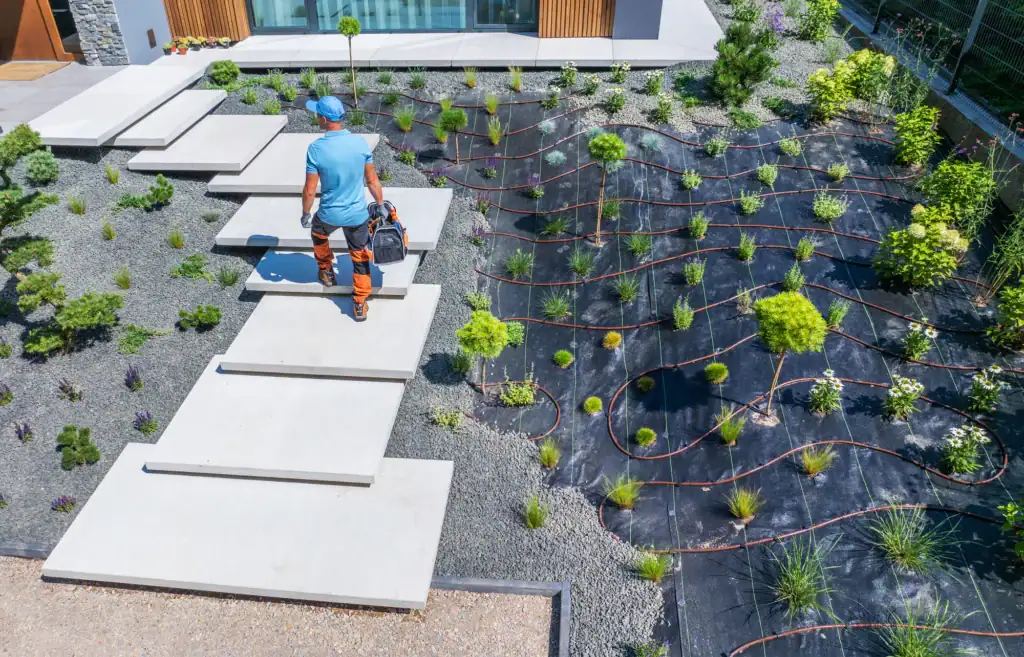
For most residential properties in Southampton, East Hampton, or Bridgehampton, a properly designed system includes rotor heads for open lawn areas, spray heads for tighter zones, and drip emitters for garden beds or shrubs. Each zone is calibrated to the specific water pressure and flow rate available, so you’re not over-saturating one corner while another dries out.
The reason this matters more on Long Island than in most markets comes down to the soil. Sandy loam — which dominates the East End — drains water faster than clay-heavy soils found elsewhere. Water applied too slowly or too infrequently runs off before roots can absorb it. A well-designed underground system accounts for this with shorter, more frequent cycles timed to how this specific soil actually behaves.
Underground Irrigation System Design for Long Island's Specific Conditions
The design phase is where most systems either succeed or fail — and it’s where local knowledge matters most. A contractor who’s never worked on the East End may design a system built for average suburban conditions. That system will underperform here, because Suffolk County’s conditions aren’t average.
Start with water pressure. Properties throughout Suffolk County vary significantly in their available water pressure depending on the water district, the size of the supply line, and how far the property sits from the main. A system designed without accounting for actual pressure at the point of connection will either run at too low a pressure — causing poor head-to-head coverage — or stress the pipes over time.
Then there’s salt air. Properties within a few miles of the Atlantic Ocean or Peconic Bay are exposed to corrosive salt-laden air year-round. Metal irrigation components — valve bodies, fittings, certain sprinkler head types — corrode prematurely if the wrong materials are specified. We’ve been working on coastal properties in Southampton and Amagansett for over 20 years, and we’ve seen what happens when a contractor uses standard components in a salt-air environment. It’s an expensive lesson for the homeowner.
There’s also the freeze-thaw reality. Long Island winters are genuine. Underground pipes left with water in them will crack and burst when the ground freezes — typically starting in November. A properly installed system includes a compressed-air blow-out before the first hard freeze, clearing every zone of standing water. This isn’t optional maintenance. It’s the difference between a system that lasts 20 years and one that needs a major repair in year two.
Smart controllers are increasingly standard on quality installations. These devices adjust watering schedules automatically based on local weather data — pausing during rain events, scaling back during cooler stretches, and compensating during dry spells. For seasonal homeowners who aren’t in residence to monitor conditions, a smart controller is what keeps the system from running uselessly during a rainstorm or failing to compensate during a dry August.
Does an Underground Sprinkler System Increase Home Value in the Hamptons?
This is the question most homeowners are really asking when they consider whether underground sprinklers are worth it. And the honest answer is: yes, in this market more than most.
Real estate professionals estimate that a quality system can increase a home’s value by 7–15%, depending on the property and market. In a market where median home prices in Southampton and East Hampton regularly exceed $1.5 million, that percentage represents real money.
But the more relevant point for Hamptons properties isn’t just the resale math. It’s the condition of the asset between now and whenever you sell. A lawn that browns out every summer, or landscaping that struggles through dry stretches because it’s being watered inconsistently, erodes curb appeal and signals deferred maintenance to anyone walking through. In a neighborhood where properties are maintained to a high standard, a struggling landscape stands out — and not in a good way.
There’s also a practical argument for seasonal and second-home owners that has nothing to do with resale value. If you’re in Manhattan most of the week and your Bridgehampton property is sitting unattended, your landscaping investment is exposed. An automated yard irrigation system protects that investment whether you’re there or not. You return to a property that looks the way it should — not one that needs emergency lawn repair before a summer rental or family visit.
The honest caveat: a poorly installed system, or one that isn’t properly maintained, won’t deliver any of this. The return on investment assumes a quality installation by a licensed contractor who understands the specific conditions of your property. That’s not a small distinction in a market where unlicensed operators are common and the consequences — failed water district inspections, voided warranties, premature component failure — fall entirely on the homeowner.
Sprinkler Maintenance in Suffolk County: What's on You and What Needs a Pro
One of the most common concerns we hear from homeowners considering underground sprinklers is maintenance. Nobody wants to invest several thousand dollars in a system and then feel like they’ve signed up for a new recurring problem. The good news is that a properly installed system doesn’t demand much from you day-to-day. The annual service requirements are predictable, and most of them require a professional for good reason.
Understanding what falls on your plate versus what needs a licensed contractor is the clearest way to set honest expectations — and it’s something most contractors never bother to explain upfront.
What Homeowners Can Handle Themselves

The homeowner’s role in maintaining an underground sprinkler system is largely observational. You’re looking for things that are visibly wrong — a sprinkler head that’s been clipped by a lawn mower and is now spraying sideways, a zone that seems to be running longer than usual, a soggy patch of lawn that might indicate a slow leak underground, or a controller that’s showing an error code after a power outage.
Adjusting your watering schedule seasonally is also something most homeowners can do on their own once the system is set up. Early in the spring, when temperatures are cool and rainfall is more frequent, you’ll water less. By July and August — when Long Island summers can go weeks without meaningful rain — you’ll run the system more. A smart controller handles much of this automatically, but knowing how to override the schedule manually is useful.
Checking that each zone’s heads are clear of debris, grass overgrowth, or soil buildup is a simple walk-around task that takes a few minutes. Heads that are partially blocked deliver uneven coverage, which defeats the purpose of a zoned system. If you notice a head that’s stuck, tilted, or not rotating properly, that’s worth flagging for your next service visit rather than ignoring until it causes a dead zone in your lawn.
What you’re not responsible for — and shouldn’t attempt without the right equipment — is anything involving the valves, the backflow preventer, the underground pipe connections, or the seasonal blow-out. These require specific tools, technical knowledge, and in the case of backflow testing, a New York State certification.
The Annual Professional Service Requirements Every Suffolk County System Needs
There are two non-negotiable professional service visits every underground sprinkler system in Suffolk County requires each year: spring startup and fall winterization. Everything else is situational.
Spring startup typically happens in March or April, once the ground has thawed and overnight temperatures are consistently above freezing. A technician pressurizes the system, runs each zone, checks every head for proper operation, inspects the valves and controller, and adjusts coverage patterns if the landscape has changed since the previous season. This is also when any damage from the winter — a cracked fitting, a head that shifted during a freeze — gets caught before it wastes water or kills a section of your lawn.
Fall winterization is the more critical of the two. Before the first hard freeze — typically in November on the East End — every zone must be cleared of water using compressed air. This isn’t a garden hose and a valve. It requires a commercial-grade compressor and someone who knows the correct pressure for each zone type, because too much pressure damages heads and fittings. Done correctly, it takes 30–45 minutes and protects the entire system from freeze damage.
The third professional requirement is one many homeowners don’t know about until they receive a notice from their water district: annual backflow testing. New York State law requires that every irrigation system connected to the public water supply include a backflow prevention device, and that device must be tested annually by a certified tester. The completed NYS DOH Form 1013 is filed with your local water district as proof of compliance. If you’ve had a system installed by an unlicensed contractor who skipped the backflow preventer entirely, you may already be out of compliance — and the liability sits with you, not the contractor.
This is one of the clearest reasons why licensed installation matters in Suffolk County specifically. The permit process, the backflow device, the annual testing requirement — these aren’t bureaucratic formalities. They’re protections for your water supply and your legal standing as a property owner. A contractor who doesn’t know these requirements, or who skips them to save time, creates a problem you’ll eventually have to fix at your own expense.
Choosing the Best Sprinkler System for Your Long Island Property
Underground sprinklers are worth the investment on Long Island — but only when the system is designed for the conditions that actually exist here. Sandy soil, salt air, coastal freeze cycles, and Suffolk County’s specific permit and backflow requirements aren’t details we work around. They’re the starting point for every decision about zone layout, material selection, and controller configuration.
The difference between a system that performs for 20 years and one that causes problems within the first few seasons usually comes down to who installed it and whether they actually understood the property. That’s not a small thing when the work is buried under your lawn.
If you’re ready to stop guessing about your landscape’s water needs and want a system designed specifically for your property, we’ve been doing this work in Southampton, East Hampton, Bridgehampton, and across the East End for over 20 years. Give us a call at (631) 678-5629 — we’re happy to walk through what your property needs before you commit to anything.