Summary:
You set the timer in April. It’s now August, and it’s rained four times this week — but your sprinklers ran anyway. That’s not a minor inconvenience. That’s hundreds of gallons of wasted water, a water bill you didn’t need, and a system that has no idea what’s actually happening outside.
For homeowners across Suffolk County, this is a familiar frustration. The good news is that it’s a solved problem. Smart irrigation systems have been around long enough to be reliable, affordable, and genuinely simple to use — even if you’re not a tech person. Here’s what they actually do, and why the difference matters for a property like yours.
What a Smart Irrigation System Actually Does Differently
A traditional sprinkler irrigation system runs on a schedule you set manually. It doesn’t know if it rained last night. It doesn’t know the forecast calls for a nor’easter this weekend. It doesn’t know that your lawn has been sitting underwater for three days. It just runs — because that’s what you told it to do in the spring, and nobody changed it.
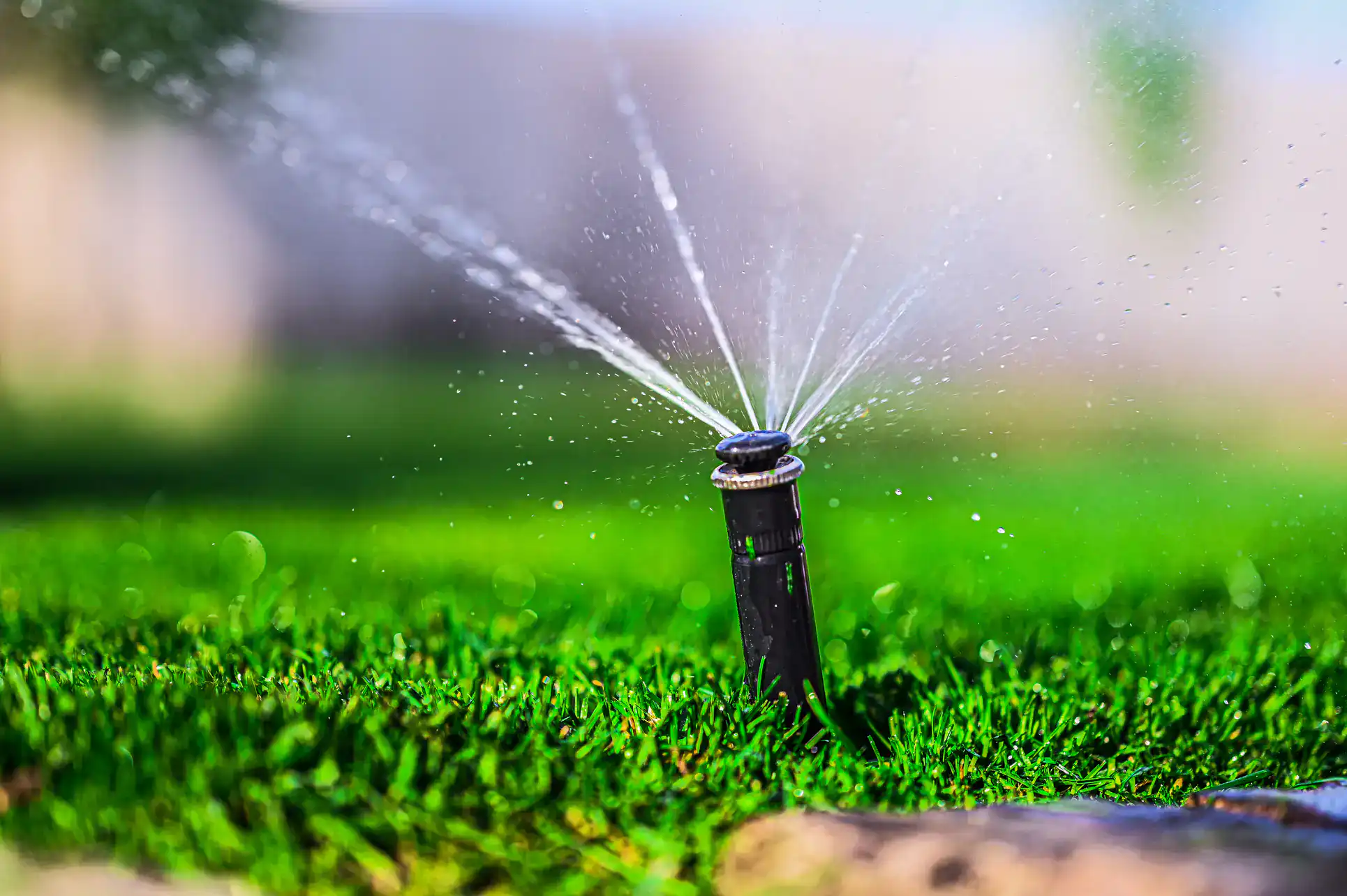
A smart irrigation system replaces that fixed timer with a controller that reads real weather data, adjusts automatically, and gives you visibility into what’s happening from your phone. It skips cycles when rain is detected. It waters more when temperatures spike. It treats your property like a living system — because that’s what it is.

How Smart Controllers Use Weather Data to Protect Your Lawn
The core technology behind a smart irrigation system is something called ET scheduling — evapotranspiration, if you want the full term. It sounds technical, but the idea is straightforward. The controller pulls in local weather data — temperature, humidity, wind speed, solar radiation — and calculates how much water your lawn and plants actually lost that day. Then it replaces only what was lost. Not more, not less.
For Suffolk County specifically, this matters more than most people realize. Long Island’s weather is genuinely variable. A July heat wave followed by a week of heavy rain is not unusual. A fixed-schedule sprinkler irrigation system can’t respond to that — it waters the same way regardless. A smart system adjusts every cycle based on what’s actually happening outside your door.
There’s also the soil factor. Long Island’s soil is predominantly sandy and glacially deposited, which means it drains faster than most regions. Water that sits too long in a single cycle doesn’t absorb — it drains past the root zone and is gone. Smart controllers can be programmed for short, frequent cycles that match how your specific soil absorbs water, which is something a manual timer simply can’t replicate with any precision.
The EPA’s WaterSense program has documented that replacing a standard clock-based controller with a smart controller saves the average home up to 15,000 gallons of water per year. That’s not a rounding error — that’s a meaningful line item on your water bill, season after season. Most homeowners see the cost of a smart controller upgrade pay for itself within two to three years through water savings alone.
Remote Monitoring — Why It's Not Just a Convenience Feature for Hamptons Homeowners
If you’re spending weeks at a time in the city between visits to your Hamptons property, remote monitoring is the whole point. A smart irrigation system lets you open an app, check whether your system ran last night, confirm it’s skipping this weekend’s rain, or shut everything down entirely — from wherever you happen to be.
Think about what that actually solves. You leave on a Sunday. It rains Tuesday through Thursday. Your traditional sprinkler system waters anyway, every morning at 6am, because it doesn’t know. You come back two weeks later to a lawn that’s been overwatered for ten days straight, with runoff pooling against your foundation and a water bill that reflects every one of those unnecessary cycles.
With a smart system, you’d have seen the rain forecast in the app, confirmed the system skipped those days automatically, and moved on with your week. No calls to a neighbor to check on things. No manual adjustment from a controller you can barely remember how to operate.
This is the dynamic that makes smart irrigation genuinely different for the East End market. Southampton, East Hampton, Bridgehampton — these are communities where a significant number of homeowners are managing properties they’re not physically present at for weeks at a time. The landscape investment at these properties is real. A professionally designed garden or lawn in this market can represent tens of thousands of dollars in plantings, grading, and installation. A smart irrigation system is what protects that investment when you’re not there to watch it.
The Suffolk County Water Authority has also issued Stage 1 Water Emergencies during drought conditions, covering all 1.2 million customers county-wide and restricting irrigation timing. During those periods, officials have specifically pointed to smart controllers as the practical solution — systems that automatically adjust to drought conditions without requiring the homeowner to manually reprogram anything. If you’re in the city when a water emergency is declared, a smart system handles the compliance for you.
Smart Irrigation Installation in Suffolk County — Why the Contractor You Choose Actually Matters
Smart irrigation technology is only as good as the installation behind it. A poorly designed system — even one with a sophisticated controller — will still waste water, miss zones, and underperform. And in Suffolk County, there are legal requirements around irrigation installation that a lot of homeowners don’t know about until something goes wrong.
The contractor you hire isn’t just a technical decision. It’s a compliance decision. And in this market, those two things are more connected than most people expect.
What Suffolk County Law Actually Requires for Irrigation Installation
Here’s something most irrigation contractors won’t walk you through upfront: in Suffolk County, certain parts of an irrigation installation are legally required to be performed by a licensed master plumber. Specifically, the backflow preventer — the device that keeps irrigation water from flowing back into the public water supply — must be installed by a licensed plumber under the Suffolk County Code of Rules Governing Restricted Licensed Plumbers. This isn’t a technicality. It’s a public health protection, and the county enforces it.
Beyond installation, New York State requires that all backflow prevention devices be tested annually by a NYS Certified Backflow Tester, with results filed with the Suffolk County Department of Health Services and your local water district. If you had an irrigation system installed by someone who skipped this step, that liability sits with you as the property owner — not the contractor who’s long since moved on to the next job.
This is one of the reasons why hiring a licensed, insured contractor for smart irrigation work isn’t just about quality — it’s about protecting yourself. An unlicensed contractor who installs a system without proper backflow prevention, skips the permit process, or never mentions annual testing requirements may charge less upfront. But they’re leaving you exposed in ways that can be expensive to fix later, especially if the Suffolk County Department of Health Services gets involved.
We’ve been working in this market for over 20 years. We know what compliance looks like here, and we don’t cut corners on the parts that matter legally — because those are also the parts that matter most to the long-term performance of your system.
Do You Need to Replace Your Entire Sprinkler System to Go Smart?
This is one of the most common questions we hear, and the answer is almost always no. In most cases, a smart controller can be installed in place of your existing timer box, connecting directly to the wiring and zones already in place. The pipes stay. The heads stay. The valves stay. Only the brain of the system changes — and that’s the part doing all the work.
That said, a retrofit is also a good opportunity to evaluate what’s already there. If your existing sprinkler irrigation system has zones that were designed without much thought — one schedule for a sunny lawn and a shaded garden bed, for example — a smart controller will improve efficiency, but it won’t fix a fundamentally poor zone layout. Part of what we do before any installation is walk the property and understand how it’s actually being used: which areas get full sun, where the drainage runs, what’s been planted, and how the existing system is performing.
When irrigation is part of a broader project — a new landscape installation, a hardscape renovation, a drainage solution — we design the irrigation around everything else. The smart controller accounts for the retaining wall that creates a drainage shadow on the east side. The drip zones feed the beds that were just installed in the patio renovation. These systems work better when they’re designed together, and that’s only possible when one contractor understands all of them.
Our 1-Year Warranty covers every component of the installation — the smart controller, the sensors, and the traditional sprinkler irrigation system elements like heads, valves, and piping. If anything fails or underperforms in the first year, we come back and correct it. That’s a written commitment, not a verbal assurance, and it applies to the whole system — not just the parts that were easiest to install.
Is a Smart Irrigation System Worth It for Your Suffolk County Property?
For most homeowners in this area — especially those managing properties they’re not at every day — the answer is straightforwardly yes. The water savings are documented and real. The remote control is genuinely useful, not just a feature on a spec sheet. And the compliance requirements in Suffolk County mean that a professional installation done right the first time is worth considerably more than a cheaper job that cuts corners on the parts you can’t see.
The technology itself is simpler to use than a traditional timer once it’s properly set up. You don’t need to adjust it every season. You don’t need to remember to reprogram it before a drought restriction kicks in. It handles that — and you get on with your week.
If you’re thinking about upgrading your current system or installing a new one, we’re based right here in Southampton and have been working across the East End for over 20 years. Give us a call at (631) 678-5629, Monday through Friday, 9am to 5pm. We’re happy to talk through what your property actually needs before anything else.